Voyager 1: Humanity’s Farthest Messenger to the Stars
Hey there, fellow space traveler.. ever wonder what it’s like to send a piece of humanity farther than any object has ever gone? Voyager 1 is that story. Launched in 1977, this car-sized probe has been whispering back from over 25 billion kilometers away for nearly five decades. It flew past Jupiter’s volcanoes, Saturn’s rings, crossed into interstellar space, and still carries a golden record with Earth’s greatest hits. In this ultra-detailed guide, I’ll walk you through every phase of its epic journey.. from the rare planetary alignment that made it possible, the engineering genius behind gravity assists, the mind-blowing discoveries at Jupiter and Saturn, the historic exit from the solar system, the Golden Record’s contents and creation process, the 2025 engineering saves, and what it’s teaching us about the space between stars. Updated to November 2025 with the latest NASA data, this is perfect for students, teachers, or anyone who loves space. No jargon. Just the real, expanded story.. over 3500 words of exploration history!

Let’s start at the beginning.. the 1970s were a golden era for planetary exploration. A rare alignment happens every 175 years: Jupiter, Saturn, Uranus, and Neptune line up in a way that allows a single spacecraft to visit all four using gravity assists. NASA originally planned a “Grand Tour” with four probes, but budget cuts in the early 1970s scaled it back. Still, they launched two identical spacecraft: Voyager 2 on August 20, 1977, and Voyager 1 on September 5, 1977. Why the order flip? Voyager 1 took a faster trajectory to reach Jupiter first, overtaking its twin. Built by JPL, each weighed 825 kg and cost about $865 million total (around $4.2 billion today). They rode Titan IIIE-Centaur rockets from Cape Canaveral. The probes were designed for a 5-year mission.. but clever power management and robust engineering have kept them going for 48 years and counting.
Power comes from three radioisotope thermoelectric generators (RTGs) using plutonium-238 decay. No solar panels.. too far from the Sun. Instruments include imaging cameras, infrared and ultraviolet spectrometers, magnetometers, plasma detectors, cosmic ray subsystems, and more. Data is sent via a 3.7-meter high-gain antenna at speeds starting at 115 kbps near Earth, now down to 160 bps from interstellar space. The onboard computers? Just 68 KB of memory.. less than a modern smartphone photo!
The Launch: A Once-in-a-Lifetime Window and Gravity Assist Magic
The Grand Tour window was closing fast. Voyager 1 launched on September 5, 1977, sixteen days after Voyager 2, to take the shorter path to Jupiter (arriving March 1979 vs. July 1979 for Voyager 2). The Titan IIIE rocket gave it an initial speed of over 38,000 mph. But fuel was limited.. only 104 kg of hydrazine for attitude control and trajectory corrections. How did it reach the outer planets? Gravity assists.. the ultimate fuel saver.
Here’s how it works: As a spacecraft flies past a planet, it enters the planet’s gravity well moving slow relative to the planet, then exits moving fast. It “steals” orbital momentum. At Jupiter, Voyager 1 gained about 10 km/s.. equivalent to accelerating from 0 to 60 mph in 0.1 seconds. Without this, the mission would’ve needed impossible amounts of fuel. Voyager 1 used Jupiter to slingshot to Saturn; Voyager 2 continued to Uranus and Neptune. This technique, pioneered by Michael Minovitch in the 1960s, has been used in every outer planet mission since.. including New Horizons and Juno.
Fun fact: The alignment was so precise that a delay of just a few years would’ve made the Grand Tour impossible for centuries. NASA seized the moment!
Jupiter: A World on Fire and Unexpected Wonders
March 5, 1979.. Voyager 1 flies within 172,000 miles of Jupiter’s cloud tops, closer than any previous probe. It captures 19,000 images.. more than all prior Jupiter missions combined. The planet’s atmosphere churns with storms; the Great Red Spot is a hurricane twice Earth’s size with 432 km/h winds, raging for at least 350 years (possibly since 1665).
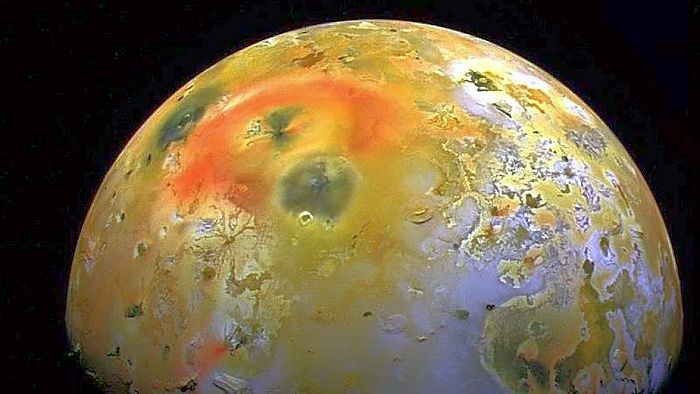
Biggest shock? Io’s volcanoes. Nine active plumes erupted during the flyby, shooting sulfur lava 300 km high. Tidal heating from Jupiter’s gravity (and resonances with Europa and Ganymede) flexes Io like a rubber ball, generating heat via friction. Over 400 active volcanoes exist today, confirmed by later missions. Europa’s smooth, cracked ice hinted at a subsurface ocean.. now a prime target for life. 2024’s Europa Clipper launch will map it in detail. Ganymede revealed a magnetic field.. the only moon with one. Callisto showed ancient, cratered terrain. Voyager also discovered a faint ring system.. dusty particles from impacts. Jupiter’s magnetosphere is massive, trapping particles in radiation belts deadly to electronics.. Voyager’s instruments measured fields 20,000 times stronger than Earth’s.
Data from Voyager reshaped planetary science. It inspired Galileo (orbited 1995-2003) and Juno (2016-present). In 2025, Juno’s extended mission still uses Voyager baselines to study long-term changes in the Great Red Spot.
Saturn: Rings, Moons, and a Hexagon Mystery
November 12, 1980.. Voyager 1 passes 77,000 miles above Saturn’s clouds. It images the rings in stunning detail, revealing thousands of ringlets, gaps (like the Cassini Division), braids, and dark “spokes” caused by magnetic fields lifting dust particles. The rings aren’t solid.. they’re 95% water ice with trace rocks, spanning 282,000 km but only 10-100 meters thick.
Titan’s thick nitrogen atmosphere (1.5 times Earth’s pressure) hides methane lakes, rivers, and organic dunes. Voyager’s radio signals probed the haze, revealing a greenhouse effect. Later Huygens probe (2005) landed there. Enceladus showed cryovolcanoes at its south pole.. water plumes confirmed by Cassini (2004-2017) to contain salts and organics, hinting at a global ocean. Mimas looks like the Death Star with its Herschel crater. Hyperion is a chaotic tumbler. And Saturn’s north pole? A persistent hexagon storm, six-sided, 30,000 km wide.. likely a standing wave in the jet stream. 2025 models suggest depth to 300 km below clouds.

After Saturn, Voyager 1’s trajectory flung it out of the ecliptic plane.. no more planets. Voyager 2 continued the Grand Tour. Voyager 1’s Saturn flyby was risky; it prioritized Titan imaging, nearly losing antenna lock. But it worked!
Leaving Home: The Long Goodbye and Interstellar Milestones
Post-Saturn, Voyager 1 headed into the void. Key milestones:
- 1990: Family Portrait.. Earth as a “pale blue dot” from 6 billion km. Carl Sagan’s famous reflection.
- 1998: Surpasses Pioneer 10 as farthest human object at 69 AU.
- 2004: Enters termination shock (94 AU).. where solar wind slows abruptly.
- 2012: Crosses heliopause (121 AU).. into interstellar space. Solar particles drop, cosmic rays spike, plasma density jumps 40x.
- 2025: At 169 AU, speed 17 km/s (3.6 AU/year), heading toward Ophiuchus.
Interstellar space isn’t empty. The heliopause is a turbulent boundary. Voyager measures magnetic fields aligned with the heliosphere, stronger than predicted. Plasma waves create a faint “hum” from solar bursts. Hydrogen levels exceed models. In 2025, data helps refine heliosphere shape.. likely crooked due to interstellar magnetic fields.
The Golden Record: A Message for Whoever Finds It
Mounted on Voyager 1 (and 2) is a 12-inch gold-plated copper disc.. a time capsule curated by Carl Sagan’s team in 1977. It includes:
- 115 images: Earth landscapes, animals, humans (anatomy, eating, UN building), DNA structure, solar system diagram.
- Sounds: Thunder, birds, whales, wind, rain, human laughter, a kiss, tools, a train, a baby crying.
- Music: 27 tracks.. Beethoven’s 5th, Bach, Chuck Berry’s “Johnny B. Goode,” Louis Armstrong, traditional music from China, India, Peru, Senegal, Navajo chants, Pygmy girls’ song.
- Greetings: 55 languages, including ancient Akkadian, plus whale song.
- President Carter’s message: “We cast this message into the cosmos… We hope someday, having solved the problems we face, to join a community of galactic civilizations.”

The cover has etched instructions (using hydrogen atom wavelength), a pulsar map (14 pulsars with frequencies to locate Earth), and a stylus/cartridge. The disc can last a billion years in space. Creation was rushed.. six weeks, $20,000 budget. Ann Druyan (Sagan’s wife) recorded her brainwaves while thinking of love. Odds of alien discovery? Near zero.. but it’s a symbol of hope.
2025: Still Talking After All These Years.. Engineering Saves and Future Silence
November 2025: Voyager 1 is 169 AU away, signals take 23 hours one-way. Power from RTGs drops 4 watts/year; now ~240 watts. Instruments shut down gradually:
- May 2025: Backup thrusters (unused since 1980 Saturn flyby) fired after heating to unclog fuel lines. Main thrusters failed due to hydrazine residue.
- February 2025: Cosmic Ray Subsystem off to save 3 watts. Voyager 2 lost plasma science instrument in March.
- Antenna upgrades: Australia’s Canberra Deep Space antenna refurb.. commands only in August/December until Feb 2026.

Remaining instruments: magnetometer, plasma wave, low-energy charged particles. Science ends ~late 2025; engineering data (attitude, temperature) until ~2036 when power <150 watts. Then silent drift.. but it’ll outlive Earth, passing a star in 40,000 years.
Why Voyager Still Matters: Legacy in Missions, Education, and Inspiration
Voyager revolutionized planetary science. It discovered 24 moons, ring systems, atmospheres, and geological activity. Data enabled Cassini, New Horizons, Juno, Europa Clipper. Over 100,000 teachers use Voyager lessons; NASA’s “Eyes on the Solar System” lets you simulate the journey. Sagan’s Pale Blue Dot speech inspires environmentalism. In 2025, Voyager data refines interstellar medium models for future probes like Interstellar Probe (proposed 2030s launch).
Kids build Golden Record replicas; citizen science projects analyze old data. Voyager is humanity’s backup.. a message that we existed, explored, and dreamed.
Conclusion: The End of the Story? Not Really
Voyager 1 is old, power-fading, but still sending whispers from the edge. It reminds us exploration never ends.. it evolves. Keep looking up.. the stars carry our story!
References & Further Reading
science.nasa.gov/mission/voyager/ – Official updates and mission overview.
jpl.nasa.gov/missions/voyager-1 – Technical details and engineering logs.
solarsystem.nasa.gov/missions/voyager-1/in-depth – In-depth science results.
planetary.org/space-missions/voyager – Latest engineering saves and power status.
voyager.jpl.nasa.gov/golden-record/ – Full tracklist and images.
Common Questions
It’s a NASA space probe launched in 1977 to study Jupiter, Saturn, and beyond. It’s now the farthest human-made object, traveling through interstellar space with a Golden Record onboard.
August 25, 2012. It crossed the heliopause at 121 AU, where the Sun’s influence ends. Cosmic rays increased, solar particles dropped to zero.
Active volcanoes on Io, a possible ocean under Europa’s ice, a massive storm called the Great Red Spot, and a faint ring system. It took 19,000 images.
Images of Earth, sounds of nature and humans, music from Beethoven to Chuck Berry, greetings in 55 languages, and a map to our solar system using pulsars.
In 2025, it’s 169 AU away, over 25 billion kilometers. Signals take 23 hours to reach Earth.
Science instruments will shut down by late 2025. Basic signals might continue until around 2036. After that, it will drift silently.
It transformed planetary science, inspired new missions, and carries humanity’s message to the stars. Its data is still used today.
The spacecraft gains speed by “stealing” momentum from a planet’s orbit. At Jupiter, Voyager 1 gained 10 km/s without using fuel.
Outer planets aligned every 175 years, allowing gravity assists to visit multiple worlds efficiently. Next chance: 2152.
Stronger magnetic fields, plasma “hum” from solar bursts, higher hydrogen levels. Helps map the heliopause boundary.