James Webb Space Telescope: The Monster Mirror That Sees the Baby Universe
Heyy space addicts… if you thought Hubble was wild, buckle up, because today we’re talking about its insane successor – the James Webb Space Telescope, or JWST. This thing is so ridiculously over-the-top that NASA literally launched a gold-plated, tennis-court-sized, origami-folding, cryogenic monster a million miles from Earth just to look at the first stars that ever existed. And it actually works. Grab the strongest coffee you’ve got… this is gonna be a long one.
That golden hexagon glow you see everywhere now? That’s Webb, chilling a million miles out, colder than Pluto, staring 13.6 billion years back in time like it’s no big deal…
The Dream That Started in 1996… Yes, Really
 NASA
NASA
Most people think Webb is “Hubble’s replacement”, but the idea actually started in 1989, just as Hubble was having its blurry meltdown. Astronomers said “okay, next one needs to see the very first galaxies, the ones that formed just a few hundred million years after the Big Bang”. To do that you need infrared vision, because light from that far back has been stretched (redshifted) into infrared wavelengths. And infrared telescopes hate heat… so the new one had to be cold. Really cold.
They called it the Next Generation Space Telescope at first. In 2002 they renamed it after James E. Webb, the NASA administrator who got Apollo off the ground. Development was… painful. Budget went from $500 million to almost $10 billion. Launch date slipped from 2007 to 2011 to 2018 to 2021. Congress threatened to cancel it multiple times. Northrop Grumman, NASA, ESA, and the Canadian Space Agency all had to work together perfectly. One tiny mistake and the whole thing would be trash.
The Most Insane Engineering Project in Human History
 ESA
ESA
Webb is not a telescope… it’s a spaceship that turns into a telescope. After launching on Christmas morning 2021 on an Ariane 5 from French Guiana, it had to do 344 single-point-of-failure steps perfectly in the next month. Unfold 18 gold-coated beryllium mirror segments into a 6.5-meter hexagon. Deploy a five-layer sunshield the size of a tennis court. Cool the instruments to 7 Kelvin (-266°C). Align the mirrors to within 1/10,000th the width of a human hair. One failure = dead telescope forever. No servicing missions possible at L2.
And it nailed every single step. When the first engineering images came back in early 2022, engineers cried. When the first science images dropped on July 11, 2022… the entire world lost its mind.
The First Images That Broke the Internet – July 2022
President Biden got the very first one: SMACS 0723, a galaxy cluster acting as a gravitational lens. In just 12.5 hours Webb saw thousands of galaxies that Hubble would need weeks to barely detect. Then NASA dropped the full set:
- Cosmic Cliffs in Carina Nebula – star birth in insane detail
- Southern Ring Nebula – dying stars like never seen before
- Stephan’s Quintet – galaxies ripping each other apart
- WASP-96b spectrum – first definitive detection of water in an exoplanet atmosphere
People literally cried on livestreams. Scientists said “this changes everything” about fifty times. And that was just day one.
The Science That’s Rewriting Cosmology in Real Time
We’re only three years into the mission in 2025 and Webb has already:
- Found galaxies that “shouldn’t exist” – massive, bright galaxies just 300-500 million years after the Big Bang
- Detected carbon dioxide in exoplanet atmospheres (K2-18b, TRAPPIST-1 systems)
- Taken direct images of giant exoplanets and brown dwarfs
- Seen individual stars in galaxies billions of light-years away
- Found the most distant galaxy ever (JADES-GS-z14-0, 13.6 billion light-years)
- Discovered complex organic molecules (PAHs) in the early universe
- Watched black holes being born inside dying stars
- Imaged Saturn’s rings, Uranus’s rings, and Enceladus plumes in infrared
- Found water oceans under ice on Europa and Enceladus (with way better data than anyone expected)
And that’s literally the short list. Thousands of papers already, and we’re not even halfway through the planned mission.
How This Beast Actually Works
Webb lives at Lagrange Point 2, 1.5 million km from Earth – four times farther than the Moon. It’s always in Earth’s shadow, perfect for staying cold. The five-layer sunshield keeps the science side at -223°C on the warm layer and -266°C on the cold side. The mirror is coated in real gold because gold is the best infrared reflector.
Four main instruments:
- NIRCam – main camera, near-infrared
- NIRSpec – can take spectra of 100 objects at once
- MIRI – mid-infrared camera & spectrograph, the only one cooled to 7 K
- NIRISS – Canadian instrument for exoplanet transits and first light searches
Webb vs Hubble – They’re Literally Dating
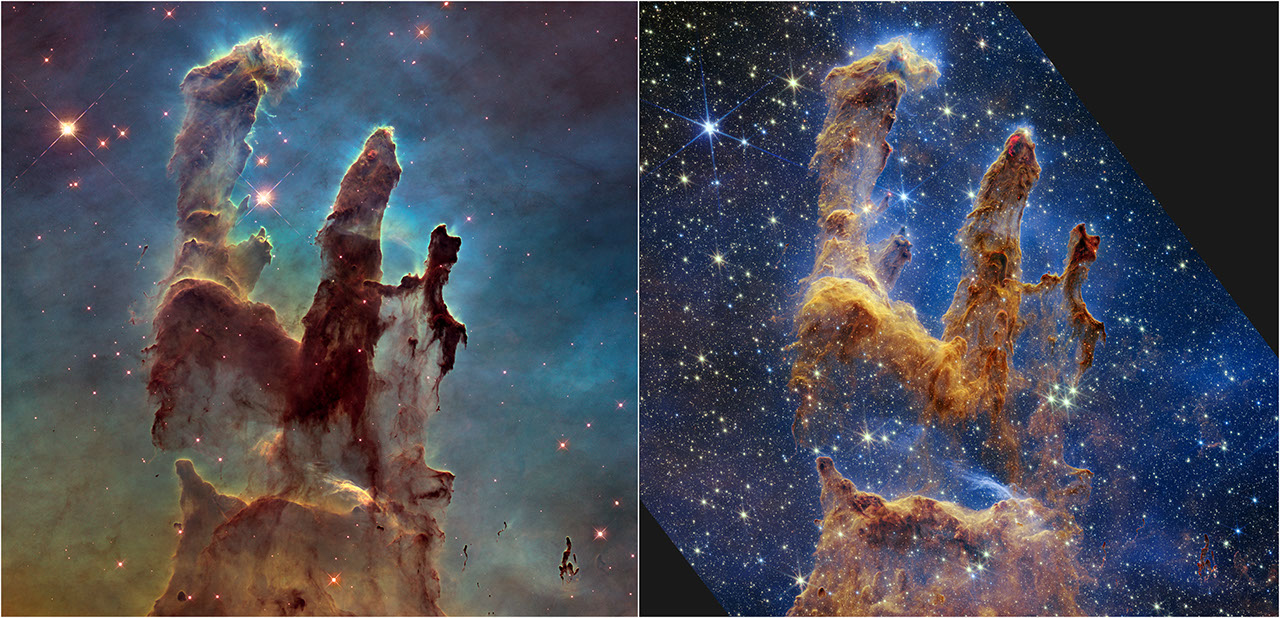
Everyone asks “which one is better?” Wrong question. Hubble sees ultraviolet and visible light. Webb sees infrared. They’re perfect partners. When they look at the same target (like the Pillars of Creation), it’s like seeing it in X-ray, visible, and infrared at the same time. Wanna know more about Hubble’s side of the story? Read my previous monster article about the Hubble Space Telescope here.
 NASA/ESA/CSA
Fun Facts That Still Blow My Mind in 2025
- The mirror is made of 18 hexagons that had to align themselves in space
- The sunshield has five layers, each thinner than a human hair
- It can see a bumblebee on the Moon from Earth (in thermal infrared)
- Every single image you see is false-color – infrared turned into visible
- It has already found over 1000 exoplanet candidates
- Its data archive will be bigger than Hubble’s entire archive in just a few years
- It will probably operate into the 2040s
Common Questions
Gold is the best reflector of infrared light – perfect for seeing the early universe.
To stay permanently in Earth’s shadow and keep the sunshield working – it needs to be colder than Pluto.
No – it’s too far. Everything had to work perfectly on deployment (and it did).
The science side reaches 7 Kelvin (-266°C), colder than deep space itself.
Webb sees in infrared, invisible to human eyes – colors are assigned to different wavelengths.
About $10 billion total – most expensive science instrument ever built.
Yes – massive galaxies at 300 million years old are forcing cosmologists to rethink everything.
No – the universe was opaque for the first 380,000 years. Webb sees the first stars and galaxies after that.
Not yet – concepts like LUVOIR or HabEx are being studied for the 2040s.
Planned 10 years, but it has fuel for 20+ if nothing breaks.
References & Further Reading
- Official JWST Site
- ESA Webb
- Public Data Archive
- Book: “The Telescope That Ate Astronomy” (coming soon)
- My previous article: Hubble Space Telescope Full Story
There you go… the telescope that sees baby galaxies, finds alien oceans, and makes astronomers question reality on a weekly basis. Drop a comment and tell me which Webb image lives rent-free in your head – for me it’s still that first deep field. Keep looking up ✨