Opportunity Rover: The Epic 15-Year Journey from 90-Day Mission to Mars Water Discoveries
Hey there space enthusiasts, it’s been a while since we tackled something this epic on CurioSpace, and honestly, Opportunity’s story hits close to home for me. This little rover, designed for a quick 90-day jaunt, ended up exploring Mars for nearly 15 years, uncovering secrets about ancient water that could rewrite our understanding of life in the universe. If you’re new to this or just want a deep dive, buckle up, we’re going all in with details that’ll make you feel like you were there on the Red Planet. Let’s explore…
Just picture this hardy explorer rolling across alien dunes, sending back data that blew minds back on Earth…
Introduction: What Opportunity Was and Why NASA Sent It to Mars
 NASA/JPL
Opportunity, also known as MER-B or simply Oppy, was part of NASA’s Mars Exploration Rover program, launched to hunt for signs of past water on the Red Planet. Why focus on water? Well, on Earth, water is the key ingredient for life as we know it, from microscopic bacteria to complex ecosystems. If Mars once had liquid water flowing on its surface or underground, it might have been habitable billions of years ago, perhaps hosting microbial life. This wasn’t just curiosity-driven science; it ties into bigger questions about whether we’re alone in the universe and how planets evolve.
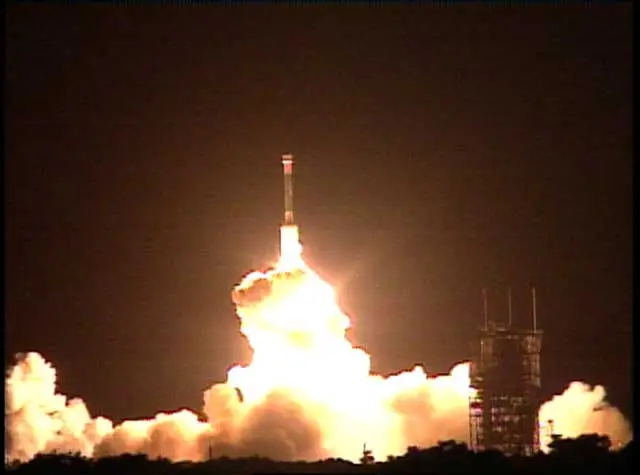
The mission’s primary goal was to analyze rocks and soil for clues of water activity, using a suite of instruments to detect minerals formed in wet environments. Launched on July 7, 2003, from Cape Canaveral, Opportunity landed on January 25, 2004, in Meridiani Planum. It was designed for just 90 sols, Martian days that last about 24 hours and 39 minutes, but thanks to clever engineering and some lucky wind gusts that cleaned its solar panels, it operated for a staggering 5,111 sols, equivalent to over 14 Earth years and 138 days. That’s like expecting your car to last three months and it chugs along for 15 years!
This longevity wasn’t accidental; it stemmed from robust design and NASA’s adaptive strategies. The rover traveled 28 miles, 45 kilometers, breaking records for off-world driving. Its discoveries, like evidence of ancient seas, have shaped subsequent missions and inspired generations. But more on that later; let’s build the foundation first.
Mission Background & Context: The Bigger Picture of Exploring Mars
To truly appreciate Opportunity, we need to zoom out to the Mars Exploration Rover, MER, program. Initiated in the late 1990s, MER aimed to send two identical rovers, Spirit and Opportunity, to opposite sides of Mars. This twin approach doubled the science return and mitigated risks; if one failed, the other could still deliver. Spirit landed in Gusev Crater, thought to be an ancient lakebed, while Opportunity targeted Meridiani Planum, where orbital data showed hematite, an iron oxide mineral often formed in water on Earth.
The program built on the 1997 Pathfinder mission’s Sojourner rover, which proved small robots could survive Mars’ harsh conditions. But MER rovers were larger, more capable, with advanced mobility and instruments. Costing about $800 million for both, the mission involved hundreds of scientists and engineers from NASA, JPL, and international partners. Mars itself is fascinating: it’s half Earth’s size, with a thin atmosphere mostly carbon dioxide, extreme temperatures from -195°F to 70°F, and features like Olympus Mons, the solar system’s tallest volcano, and Valles Marineris, a canyon dwarfing the Grand Canyon.
Scientifically, Mars holds clues to planetary habitability. Orbital evidence suggested ancient floods carved channels, but ground truth was needed. By studying diverse sites, Spirit and Opportunity provided comparative geology, revealing Mars’ wetter past. This context set the stage for Opportunity’s triumphs, showing how one rover’s data contributes to our cosmic puzzle.
 NASA
NASA
Rover Design & Technology: Breaking Down the Engineering Marvel
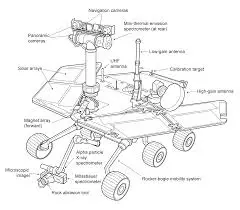
Opportunity was engineered like a tough off-road vehicle for another world. Roughly 5 feet tall, 7.5 feet wide, and weighing 408 pounds on Earth, but feeling lighter in Mars’ gravity, it was built to withstand radiation, dust, and temperature swings. Its “warm electronics box” insulated critical components like computers and batteries against freezing nights.
Power came from solar arrays generating up to 140 watts initially, dropping over time due to dust. Lithium-ion batteries stored energy for operations. The six-wheel rocker-bogie suspension allowed climbing over obstacles up to 10 inches high, with each wheel independently driven for maneuverability. This system, inspired by earlier designs, prevented tipping on slopes up to 30 degrees.
Communication used a high-gain antenna for direct Earth links and UHF for orbiters, with delays up to 20 minutes, necessitating autonomy. Now, the instruments, these were the rover’s senses:
- Panoramic Camera, Pancam: Mounted on a mast, it captured stereo color images with 14 filters for mineral identification. Resolution was like human vision, helping spot targets from afar.
- Microscopic Imager, MI: On the robotic arm, it provided close-ups at 30 microns per pixel, revealing rock textures and grains.
- Mössbauer Spectrometer: This detected iron minerals by measuring gamma ray absorption, identifying hematite or goethite, key water indicators.
- Alpha Particle X-Ray Spectrometer, APXS: Bombarded samples with particles to analyze elements like sulfur, chlorine, suggesting briny pasts.
- Rock Abrasion Tool, RAT: Grinded 2mm deep holes to expose fresh rock, essential for accurate readings.
- Navigation and Hazard Cameras: Stereo pairs for 3D mapping and obstacle avoidance.
- Mini-TES: Infrared spectrometer for remote mineral detection.
These tools, on a 5-foot robotic arm, turned Opportunity into a geologist. The design’s modularity allowed software updates from Earth, extending its life.
Journey to Mars: From Launch to Arrival
The adventure started with launch on a Delta II rocket from Florida on July 7, 2003. The seven-month cruise covered 283 million miles, with trajectory corrections using thrusters. Engineers monitored health, calibrated instruments, and prepared for entry.
Arrival on January 25, 2004, involved atmospheric entry at 12,000 mph, heat shield enduring 2,700°F, parachute deployment, then rockets and airbags for a bouncy landing. This “entry, descent, landing” sequence lasted minutes but was meticulously planned.
Landing on Mars: A Hole-in-One Touchdown
Meridiani Planum was chosen for flat terrain and hematite signals. The airbag system cushioned impact, bouncing 26 times before stopping in Eagle Crater, a 72-foot depression exposing bedrock. This lucky spot provided immediate science gold.
First images showed deflated airbags and Martian soil; color panoramas revealed outcrops. JPL erupted in cheers, with mission leads calling it a “hole-in-one.” Initial checks confirmed all systems go, setting stage for exploration.
 NASA/JPL
Early Discoveries: Uncovering Water’s Fingerprints
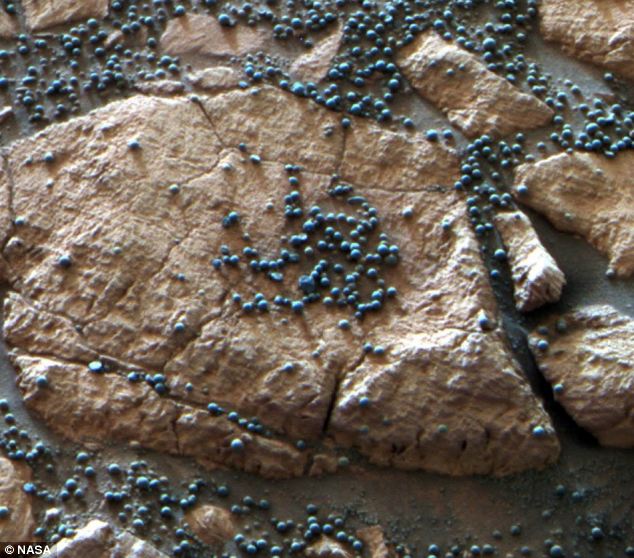
In Eagle Crater, Opportunity found “blueberries,” millimeter-sized hematite spheres formed by groundwater on Earth. Using MI and spectrometers, it confirmed their composition. Layered bedrock showed cross-bedding from water flows, with high sulfur and jarosite from acidic evaporation.
These findings, announced March 2004, proved Meridiani was once wet, perhaps a shallow sea. It was NASA’s first conclusive ground evidence of liquid water on Mars, shifting paradigms from dry to potentially habitable ancient world.
Major Exploration Phases & Sites: A Rover’s Odyssey
Opportunity’s journey unfolded in phases:
- Eagle Crater (Sols 1-84): Initial water evidence, examining outcrops like El Capitan.
- Endurance Crater (Sols 85-315): Descended into 430-foot crater, finding deeper layers with more sulfates, indicating prolonged wet periods.
- Victoria Crater (Sols 952-1630): After 5-mile trek, explored 2,400-foot crater, studying erosion and ancient environments despite wheel issues.
- Journey to Endeavour (Sols 1631-2680): Three-year, 13-mile drive, discovering meteorites and phyllosilicates en route.
- Endeavour Crater (Sols 2681-5111): Arrived August 2011, found clays like smectite in neutral water, better for life. Explored Marathon and Perseverance Valleys for flow evidence.
Each site built on previous, revealing Mars’ geological history over billions of years.
 NASA
NASA
Evidence for Water on Mars, Clearly Explained
Opportunity’s data showed diverse water evidence. Hematite blueberries indicated groundwater percolation, sulfates like jarosite from acidic lakes evaporating. At Endeavour, clays formed in milder pH, suggesting drinkable water.
Gypsum veins in Homestake were deposited by flowing water, while valley features hinted at debris flows. These prove Mars had liquid water intermittently for millions of years, 3-4 billion ago, in environments where life could thrive. No fossils found, but habitability odds rose dramatically, informing astrobiology.
Daily Operations & How the Rover Was Controlled
A sol’s routine: Wake with sunlight, recharge, execute commands like driving or analyzing. Earth teams planned via uplink, considering delays. Autonomy software handled hazards, but major decisions were human.
Power management was crucial; low energy meant hibernation. Over time, dust and wear reduced efficiency, but updates optimized operations.
Challenges & Near-Failures: Overcoming Mars’ Harshness
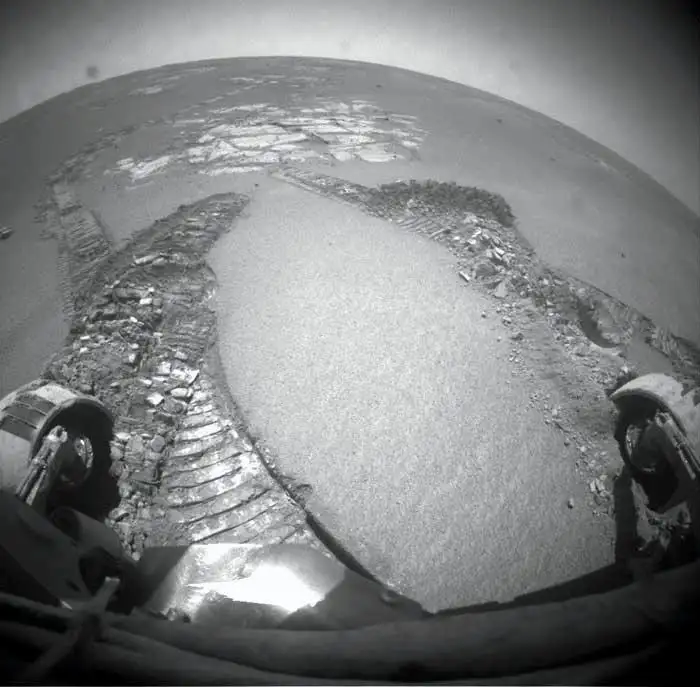
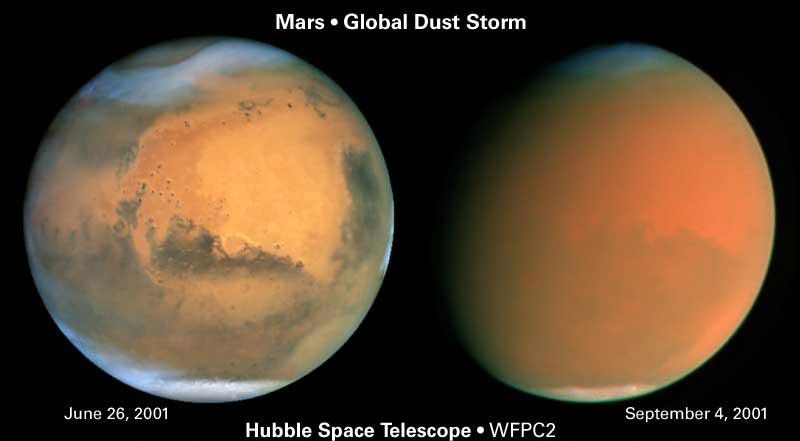
Dust storms in 2007 and 2018 slashed power; 2007 nearly ended it, but winds cleaned panels. Cold winters risked battery failure, mitigated by heaters. Mechanical issues, like jammed wheels, led to backward driving.
Stuck in Purgatory Dune for weeks in 2005, engineers simulated escapes on Earth testbeds, freeing it with careful commands. These triumphs showcased problem-solving.
 NASA
NASA
The 2018 Global Dust Storm & End of Mission
The storm, starting May 2018, engulfed Mars by June, blocking 99% sunlight. Opportunity’s last transmission June 10 showed critical low power. Recovery efforts over 1,000 commands failed; mission ended February 13, 2019.
The “battery low” quote is mythic; actual data was telemetry. Dust likely coated panels permanently, or cold damaged systems.
Scientific Impact & Legacy: Rewriting Mars’ Story
Opportunity confirmed wet, habitable ancient Mars, with over 217,000 images and data inspiring Curiosity’s nuclear power and Perseverance’s sample collection. Records: 28 miles driven, longest Mars mission.
Its findings on water diversity advanced climate models, astrobiology.
Emotional & Cultural Impact: Why We Loved Oppy
Personified as brave, Opportunity’s “selfies” and perseverance endeared it globally. End sparked tributes, documentaries like “Good Night Oppy.” It boosted STEM, showing exploration’s human side.
Key Facts & Timeline
- Launch: July 7, 2003
- Landing: January 25, 2004
- Mission Duration: 5,111 sols, about 15 years
- Planned vs Actual: 90 sols vs 5,111
- Distance Driven: 45.16 km
- End Date: February 13, 2019
- Other: First post-landing contact Jan 25; Endurance May 2004; Victoria Sept 2006; Endeavour Aug 2011; Last comm June 10, 2018
Comparison With Other Rovers
Spirit, twin, drove 4.8 miles, ended 2010 after stuck. Curiosity, car-sized, nuclear, in Gale Crater since 2012, confirmed lakes. Perseverance, 2021, Jezero Crater, samples for return, helicopter Ingenuity. Opportunity’s solar endurance set benchmarks.
Myths vs Facts Section
Myth: Sent “battery low” message. Fact: Poetic interp, not literal.
Myth: Fully sentient. Fact: No AI emotions, just code.
Myth: Found life. Fact: Habitability clues, no biosignatures.
Glossary
- Sol: Martian day
- Regolith: Loose surface material
- Spectrometer: Analyzes light/elements
- Crater: Impact depression
- Hematite: Water-formed iron oxide
- Jarosite: Sulfate mineral from acidic water
- Phyllosilicates: Clays indicating neutral water
Common Questions
Robust design, wind cleanings, software updates, careful ops.
Through minerals like hematite, sulfates, clays formed in wet conditions.
Potentially yes, with water in life-friendly pH, but no direct life evidence.
Dust storms, cold, mechanical wear, sand traps, solved by engineering.
Smaller, solar vs nuclear, but longer-lived than expected.
No, focused on geology, not biology directly.
Global, blocked sun for months, fatal for solar power.
Personification made it relatable, symbol of human spirit.
Yes, like it “knew” it was dying; it didn’t have consciousness.
Guides human missions, sample returns, search for life.
References & Further Reading
- NASA Opportunity Page
- Wikipedia on Opportunity
- Planetary Society MER Updates
- Book: “Roving Mars” by Steve Squyres
- Know About : Hubble Space Telescope
Conclusion
Opportunity’s legacy is profound, transforming Mars from a barren rock to a world with a watery past, inspiring us to reach further. Its endurance teaches resilience, and as we plan human steps there, Oppy reminds us of exploration’s power.