Big Bang Explained: What Happened Right After the Universe Began
Big bang explained in simple words.. ever wonder where everything came from? The stars, planets, even you and me? It all started 13.8 billion years ago with the Big Bang.. not a loud boom like in movies, but space itself stretching super fast from a tiny, super hot point. Think of it like a balloon inflating.. except the balloon IS the universe. In this long, detailed guide, I’ll walk you thru every step of what the big bang explained really means.. from what might’ve been before (we’ll get deep into that), the insane first fractions of a second, how the universe cooled over hundreds of thousands of years, how the first atoms formed, how gravity pulled gas into stars and galaxies, how those stars cooked the elements inside you, and finally.. how life could’ve sparked on a little blue dot called Earth. I’ll use real science, updated to October 2025 with fresh data from James Webb, Planck, Hubble, and more.. perfect if you’re a total beginner, a student, or just love space. Let’s go deep!
Let’s start with the question everyone asks first.. what was before the Big Bang? Honestly? Science hits a real wall here. The Big Bang isn’t just the start of matter.. it’s the start of space, time, and the laws of physics as we know them. So asking “what came before” is like asking “what’s north of the North Pole?” Time didn’t exist. But that doesn’t stop scientists from guessing! Some say the universe came from a quantum fluctuation.. a random pop in a sea of energy. Others think it was a “bounce” from a previous universe that collapsed. There’s even the multiverse idea.. our Big Bang was one bubble in an infinite foam of universes. In 2025, string theory and loop quantum gravity models are being tested with new math, but no hard proof yet. One wild idea? The universe might be cyclic.. expand, cool, crunch, bang again. But dark energy is pushing things apart faster now, so maybe not. Still.. super fun to think about!
Another way to look at it.. imagine zooming into the Planck scale, 10^-35 meters. That’s where quantum gravity rules, and our equations break. We need a theory of everything to peek “before.” Until then? It’s a mystery. But that’s okay.. mysteries drive science!
Big Bang Explained: What It Really Was (Not an Explosion!)
Okay, let’s clear up a huge myth right now.. the Big Bang was NOT an explosion in empty space. There was no “center,” no debris flying into nothing. The Big Bang was the moment when space itself began to expand.. and it’s still expanding today. Picture every point in the universe as the starting point. There’s no edge, no outside. It’s like raisins in rising dough.. every raisin sees others moving away, but none are the center.
The idea started with a Belgian priest and physicist named Georges Lemaître in 1927. He called it the “primeval atom.” Then Edwin Hubble looked through his telescope in 1929 and saw galaxies moving apart.. the farther away, the faster they’re going. That’s the redshift! Today we measure it with the Hubble constant.. about 70 km/s per megaparsec. The Planck satellite and James Webb Space Telescope have nailed the universe’s age to 13.787 billion years, give or take 20 million. That’s precision!
But the real smoking gun? The cosmic microwave background (CMB). In 1965, Penzias and Wilson accidentally found faint radio waves everywhere.. leftover heat from when the universe was 3000K. Now it’s cooled to 2.7K.. like an echo of the Big Bang. The CMB has tiny ripples.. exactly what inflation predicted. More on that soon.
Want to learn more? Check this: NASA Big Bang Basics or ESA on the Big Bang.
Big Bang Explained: The First Crazy Seconds (Timeline Breakdown)
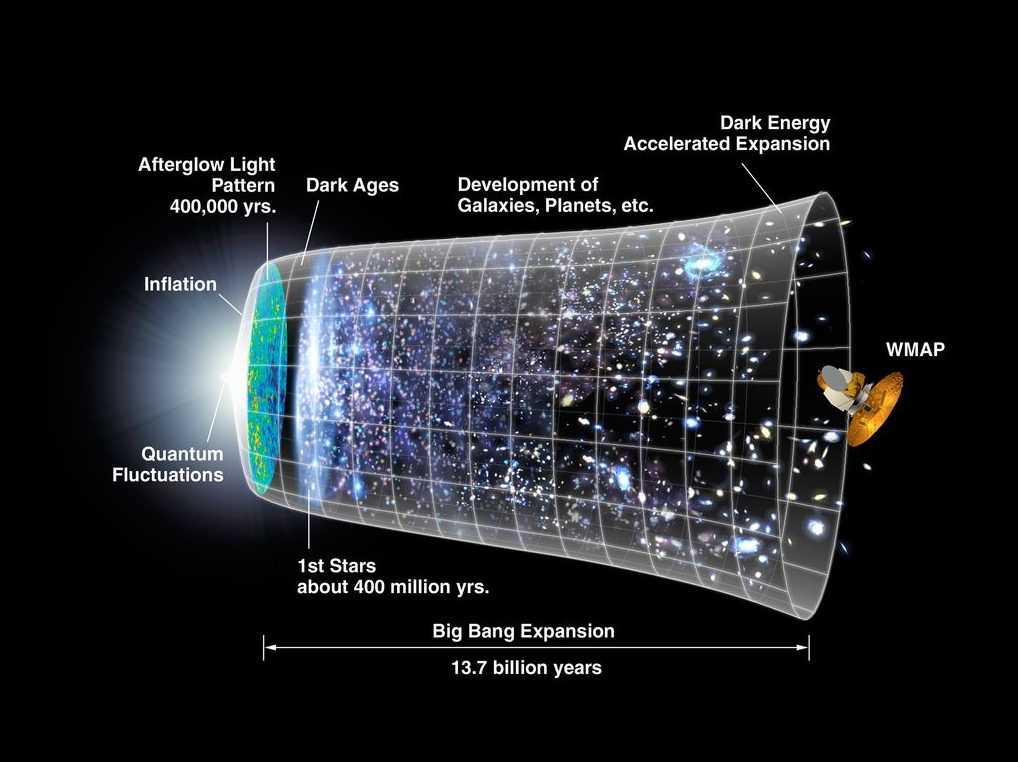
So when people ask for big bang explained in minutes.. here’s the ultra-detailed version. The early universe changed faster than you can blink. Let’s break it down era by era, with real physics and 2025 updates.
Planck Era (0 to 10^-43 seconds): This is the limit of our knowledge. Gravity, electromagnetism, strong and weak forces were unified. Temperature? Over 10^32 Kelvin. Space and time were fuzzy.. quantum foam. We need quantum gravity (maybe string theory) to describe it. In 2025, new supercomputer simulations are testing loop quantum cosmology.. hinting the singularity wasn’t infinite.
Grand Unification Era (10^-43 to 10^-36 sec): The strong force splits from the others. Particles like X and Y bosons decay, maybe creating matter over antimatter. That’s why we exist! If equal, everything would’ve annihilated.
Inflationary Epoch (10^-36 to 10^-32 sec): This is wild.. the universe expanded by a factor of 10^26 in a blink. From smaller than a proton to grapefruit-sized or bigger. Why? A hypothetical field called the inflaton. It smoothed out wrinkles, made space flat, and stretched quantum fluctuations into the seeds of galaxies. 2025 CMB polarization data from SPT-3G and Simons Observatory strongly support inflation. Without it, the universe wouldn’t look so uniform.

Electroweak Era (10^-32 to 10^-12 sec): Electromagnetic and weak forces split. Higgs field gives particles mass. Quarks and leptons form.
Quark Era (10^-12 to 10^-6 sec): A plasma of quarks, gluons, and leptons. Too hot for protons or neutrons. Like a superheated soup.
Hadron Era (10^-6 sec to 1 sec): Quarks combine into protons and neutrons. Antimatter mostly gone.. lucky for us!
Lepton Era (1 to 10 seconds): Neutrinos decouple.. they’re still flying through you now!
Big Bang Nucleosynthesis (3 to 20 minutes): The first atomic nuclei form! Protons and neutrons fuse into deuterium, then helium. Result? 75% hydrogen, 24% helium, 1% lithium and beryllium. We see this exact ratio in the oldest stars.. perfect match!
Photon Epoch (20 minutes to 380,000 years): Universe is a hot fog of plasma. Electrons and protons can’t bind.. light bounces everywhere. Temperature drops from 10^9 K to 3000 K.
Recombination (380,000 years): Electrons finally join nuclei.. atoms form! Light streams free. This is the CMB we see today. The universe goes from opaque to transparent in a flash.
The Dark Ages: A Cold, Empty Universe (380,000 to 200 Million Years)
After recombination, the universe was dark. No stars, no galaxies.. just cooling hydrogen and helium gas, plus dark matter. Expansion stretched the CMB photons, cooling the universe to a few hundred Kelvin. But tiny density fluctuations from inflation grew slowly. Dark matter clumped first.. it doesn’t interact with light, so it could collapse under gravity without radiation pressure. These dark matter halos acted like gravitational wells, pulling in normal gas.
By 100 million years, the first gas clouds collapsed. No metals (astronomers call anything heavier than helium a “metal”), so cooling was hard. Only molecular hydrogen could cool gas enough. That’s why the first stars were monsters.. 10 to 1000 times the Sun’s mass. We call them Population III stars. They burned hot and fast.. in just a few million years.
James Webb in 2025 found chemical fingerprints of these stars in galaxies at 280 million years.. way earlier than expected. Some had oxygen and carbon already.. meaning the first stars died fast and enriched space quickly.
Cosmic Dawn: First Stars and Galaxies Light Up
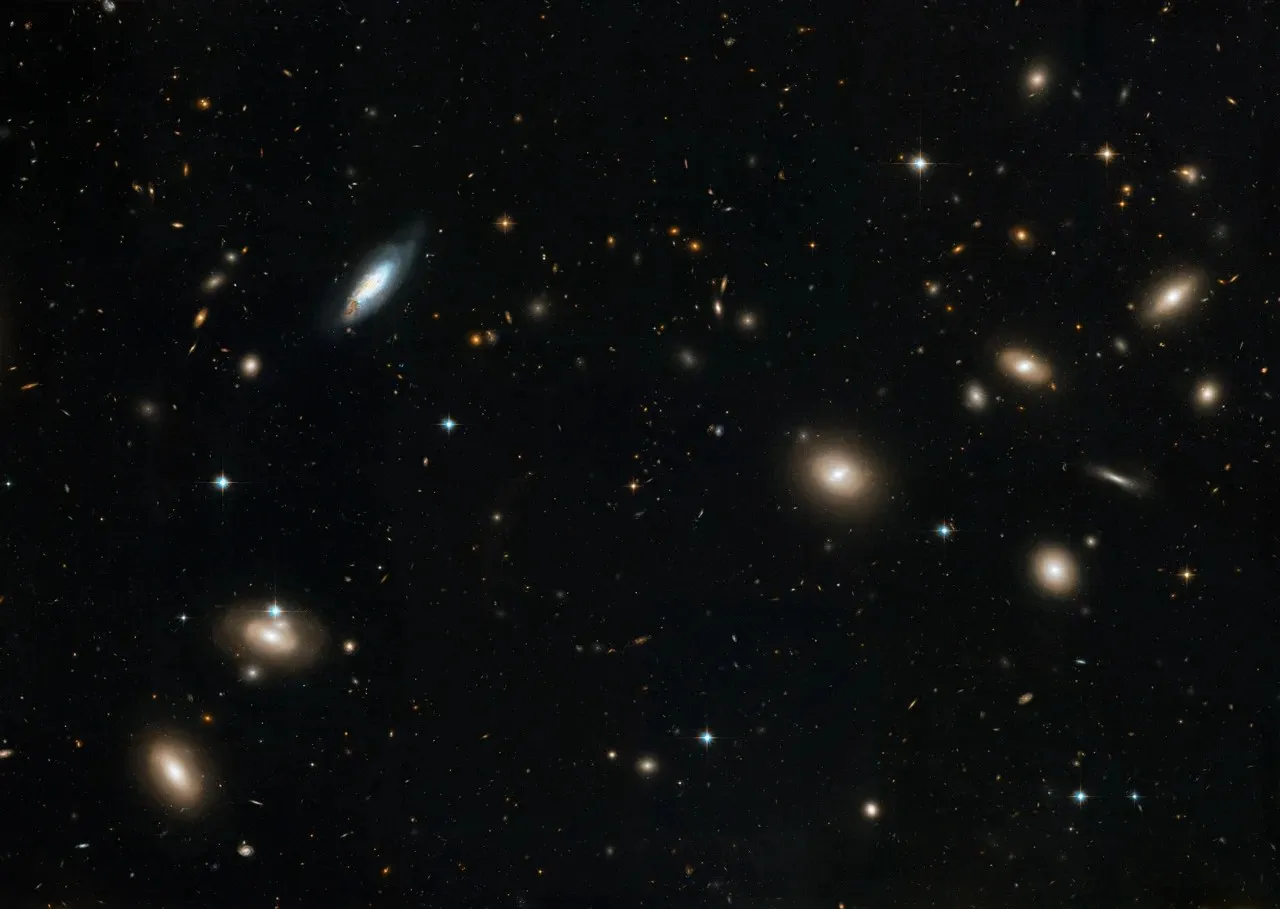
The first stars ended the Dark Ages. Their UV light ionized hydrogen.. a process called reionization. By 1 billion years, the universe was mostly reionized. Bubbles of ionized gas grew and merged. Webb sees this era clearly now.. galaxies forming in clusters around dark matter filaments.
These early galaxies were small and chaotic.. merging often. Supermassive black holes formed fast.. maybe from direct collapse of gas clouds, not just star deaths. Quasars blazed as these black holes ate matter. One found in 2025 at 400 million years had a billion solar masses.. how?! Still a puzzle.
How Galaxies Grew: Mergers, Gas, and the Cosmic Web
Gravity kept working. Dark matter formed a cosmic web.. filaments, walls, and voids. Gas flowed along filaments into nodes where galaxies grew. The Milky Way started as dozens of small galaxies merging over billions of years. Star formation peaked at “cosmic noon”.. 3 billion years after the Big Bang. That’s when most stars were born.
Today, Euclid and Nancy Grace Roman telescopes are mapping billions of galaxies to trace this web. 2025 data shows the web was in place by 1 billion years.. faster than old models predicted.
How Stars Form, Live, and Die (And Make You)
Stars are born in nebulae.. cold, dense clouds of gas and dust. Gravity pulls a clump in, it spins, heats up. At 10 million K, hydrogen fuses into helium.. a star is born! Our Sun formed 4.6 billion years ago in the Orion Spur. It’ll live 10 billion years total.
Massive stars live fast and die young. When they run out of fuel, their cores collapse. If over 8 solar masses, boom.. core-collapse supernova. This forges carbon, oxygen, iron.. elements in your body. The shockwave compresses nearby gas, triggering new starbirth. One supernova can outshine a galaxy for weeks.
Neutron stars or black holes are left behind. In 2025, LIGO detected over 300 black hole mergers.. some in the “mass gap” between 2 and 5 solar masses. Weird!
How Life Began: From Chemistry to Biology
Life needs water, carbon, energy, and time. Earth formed 4.54 billion years ago from a disk of dust around the young Sun. It was molten at first.. bombarded by asteroids. But by 4.4 billion years, it cooled. Water came from comets and volcanic outgassing. Oceans formed.
Chemistry started in those warm pools or deep-sea vents. The Miller-Urey experiment (1953) showed lightning in a primordial soup makes amino acids.. building blocks of proteins. In space, the ALMA telescope finds complex molecules in star-forming clouds. Life’s ingredients are everywhere!
By 3.8 billion years, microfossils in Australia hint at life. Maybe RNA world first.. self-replicating molecules. Photosynthesis evolved, pumping oxygen. By 540 million years, the Cambrian Explosion.. complex animals appear. Evolution took over.
Now? Webb found water vapor, CO2, and methane on exoplanets. Some in habitable zones. 2025 biosignature searches are ramping up. Life elsewhere? Likely. Intelligent? That’s the big question.
Read more: NASA Kepler | James Webb Telescope.
Conclusion: That’s the Big Bang Explained.. and We’re Still Learning
From a hot, dense point to a universe with 2 trillion galaxies.. the Big Bang started it all. Dark energy now accelerates expansion. Will it end in a Big Rip? Heat death? Or something else? Telescopes like Roman and LISA will tell us. But one thing’s clear.. you, me, Earth, the stars.. we’re all made of Big Bang leftovers. Keep looking up.. the story’s not over!
References & Further Reading
science.nasa.gov/missions/hubble/the-big-bang – Official NASA explanation with visuals.
Common Questions
Nobody knows for sure.. cause time started with the Big Bang. Maybe a quantum fluctuation, a collapsing universe, or multiverse bubble. 2025 models explore cyclic ideas, but no evidence yet.
Nah, not like a bomb.. no center, no edge. It was space itself expanding, carrying galaxies with it. Every point was the starting point!
Over 10^32 Kelvin in the Planck era.. hotter than the core of any star. Cooled to 3000K by 380,000 years when atoms formed.
Four big ones: 1) Galaxies moving apart (Hubble), 2) Cosmic microwave background, 3) Exact hydrogen/helium ratio, 4) Large-scale structure matching inflation predictions.
Between 100 and 250 million years after. James Webb found chemical signs by 2025.. massive Population III stars that lived fast and died in supernovae.
Dark matter clumped first, pulling gas in. Direct collapse black holes and mergers helped. Webb sees billion-solar-mass galaxies at 400 million years.. still a mystery!
No chance.. too hot, no atoms, no planets. Took 9 billion years for Earth-like conditions. But life’s building blocks form easily in space.
Nothing.. space itself is growing. Like the surface of a balloon.. no “outside” needed. The universe may be infinite.
Unlikely.. dark energy speeds expansion forever. Some cyclic models exist, but evidence favors one-time event.
Olbers’ paradox! The universe has a finite age and expands.. light from distant stars hasn’t reached us, and redshift dims it.