The Challenger Disaster: A Heartbreaking Chapter in Space Exploration That Still Teaches Us Today
Hey, imagine standing there on a freezing Florida morning back in January 1986, the air crisp and full of anticipation as the space shuttle Challenger prepares for liftoff. Millions around the world, including school kids in classrooms, are watching live on TV, excited for what seems like another routine step in America’s space adventure. But then, just 73 seconds after those engines roar to life, everything changes in an instant, the shuttle breaks apart in a massive fireball, and seven incredible people lose their lives right before our eyes. Even today, in December 2025, nearly four decades later, the Challenger disaster hits hard as one of the most tragic events in space history. It wasn’t merely a mechanical glitch, no, it revealed serious cracks in how organizations handle risks, make decisions under pressure, and prioritize safety in pursuits as ambitious as reaching for the stars. In this detailed article, we’re gonna explore every angle, from the lead-up to the long-lasting effects, the heroes who flew that day, the investigation that followed, and the lessons that continue to shape space travel. Whether you’re a space nut, a history fan, or just someone curious about how one event can change an entire industry, hang in there with me, cause this story has layers upon layers, and it’s as important now as it ever was.
The Roots of the Space Shuttle Program: Ambition Meets Reality
To really grasp why the Challenger disaster shook everyone so deeply, we gotta go back to the beginnings of the Space Shuttle program. Born in the late 1960s and early 1970s, right after the triumph of the Apollo moon landings, NASA was looking for the next big thing. The idea was to create a reusable spacecraft that could ferry people and cargo to space regularly, kinda like a space truck or a flying lab. President Nixon approved the project in 1972, and it promised to cut costs dramatically compared to those one-use rockets from the past. The shuttles were designed with three main components: the orbiter, which looked like a plane and carried the crew, the big external fuel tank, and two solid rocket boosters that provided the initial thrust.
Development wasn’t smooth sailing, though. Budget overruns and technical hurdles delayed the first flight until 1981, when Columbia took off successfully. By 1985, the program was humming along, with missions deploying satellites, conducting scientific experiments, and even repairing telescopes in orbit. Challenger, designated OV-099, was the second shuttle built and had already flown nine times by early 1986, proving its worth on tasks like the first spacewalk by an American woman and deploying key communications gear. But beneath the successes, pressures were building. NASA wanted to prove the shuttles could launch frequently, up to 24 times a year eventually, to justify the billions spent. This push for routine operations sometimes meant glossing over potential issues, like the known problems with the O-rings in the boosters. Those seals, made of rubber, were supposed to prevent hot gases from escaping the joints in the SRBs, but tests showed they could fail in cold weather. Engineers had raised flags as early as 1977, but with tight schedules and political expectations, those concerns often got categorized as manageable risks rather than showstoppers.
The program also aimed to democratize space, bringing in civilians like teachers and journalists to show that orbit wasn’t just for elite pilots anymore. This shift added a layer of public engagement but also heightened the stakes, as any failure would be amplified in the media spotlight.
Setting the Stage: The STS-51-L Mission and Its Unique Appeal
Now, let’s zoom in on the mission itself, STS-51-L. Originally slated for January 22, 1986, it kept getting postponed due to bad weather, technical snags, and even issues with the previous shuttle landing. The payload included the Tracking and Data Relay Satellite, crucial for better communications with spacecraft, and the Spartan-Halley platform to study Halley’s Comet, which was making its once-every-76-years pass by Earth. But what really captured the public’s imagination was the inclusion of Christa McAuliffe as part of the Teacher in Space Project. Announced by President Reagan in 1984, this initiative was meant to inspire students and boost interest in science education. McAuliffe, a social studies teacher from Concord, New Hampshire, beat out thousands of applicants and underwent rigorous training. She planned to deliver two lessons from space: one on the benefits of space travel and another on how the shuttle worked, broadcast live to classrooms nationwide.
The delays built tension, and by January 27, the weather at Kennedy Space Center was unusually cold for Florida, with temperatures dropping below freezing overnight. Ice formed on the launch pad, raising concerns about debris falling and damaging the shuttle. That evening, engineers from Morton Thiokol, the booster manufacturer, held a teleconference with NASA officials. They strongly recommended against launching, citing data from previous cold-weather flights where O-rings had eroded. One engineer, Bob Ebeling, later recalled feeling sick about the decision, but after hours of debate, Thiokol management reversed their stance under pressure, giving the green light. It was a classic case of organizational dynamics overriding technical caution, a theme the investigation would later hammer home.
Honoring the Crew: Stories of Courage and Diversity
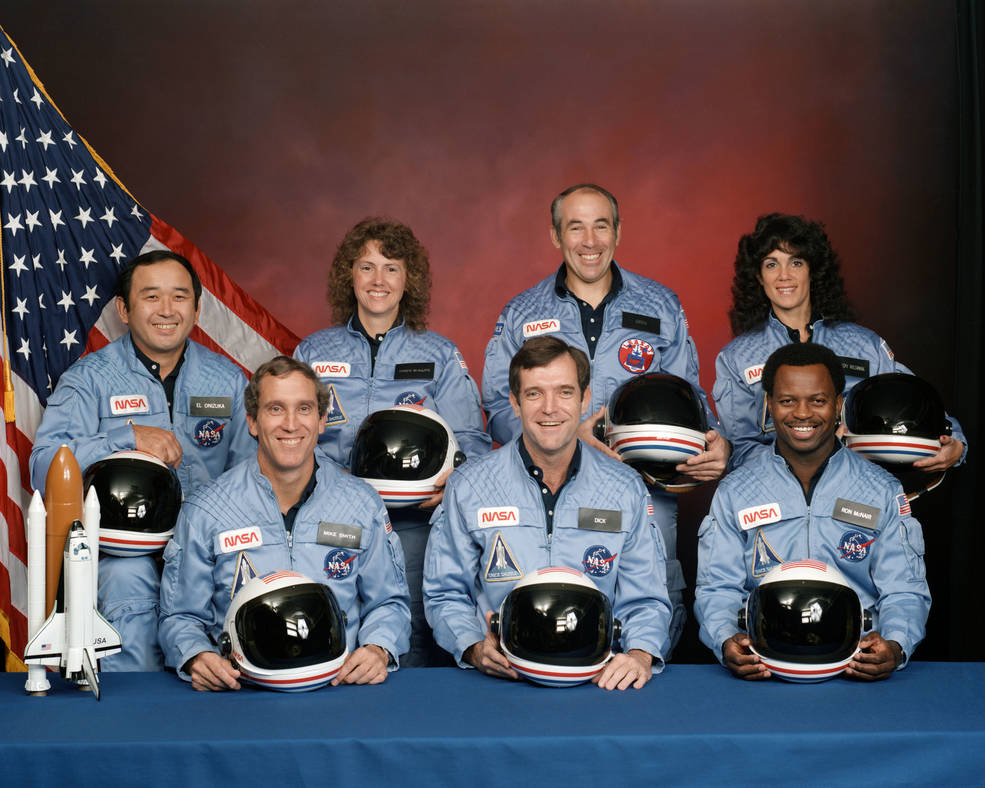
The seven souls aboard Challenger weren’t just crew members, they were trailblazers representing the best of humanity’s spirit. Let’s take a moment to remember each one, because their stories add so much depth to this tragedy.
Commander Francis R. “Dick” Scobee, 46, was a seasoned Air Force test pilot with over 6,500 hours of flight time, including combat in Vietnam. He’d flown Challenger before and was known for his calm under pressure. Pilot Michael J. Smith, 40, a Navy captain, was on his maiden space voyage but brought expertise from flying 28 different aircraft types. Judith A. Resnik, 36, the mission specialist, held a Ph.D. in electrical engineering and had been the second American woman in space on Discovery in 1984. She was a classical pianist too, blending brains and artistry.
Ellison S. Onizuka, 39, another mission specialist, was a lieutenant colonel in the Air Force and the first Asian American astronaut. From Hawaii, he embodied the aloha spirit and had flown on a classified Department of Defense mission. Ronald E. McNair, 35, a physicist with a Ph.D. from MIT, was the second African American in space. He was also an accomplished saxophonist, planning to record a solo from orbit, and had overcome racism to reach the stars.
Gregory B. Jarvis, 41, a payload specialist from Hughes Aircraft, was there to conduct experiments on fluid dynamics in microgravity, work that could advance satellite technology. And then there was Sharon Christa McAuliffe, 37, the first private citizen chosen for spaceflight. A dedicated educator, she left behind a husband and two young children, her enthusiasm infectious as she trained for months at Johnson Space Center.
This crew’s diversity, in gender, ethnicity, and background, symbolized NASA’s push toward inclusivity. Their loss wasn’t just professional, it was profoundly personal, affecting families, friends, and a nation that had come to see them as heroes.
The Fatal Sequence: What Happened in Those 73 Seconds
Launch day dawned clear but cold, with temperatures around 36°F at liftoff, far below the 53°F minimum recommended for the O-rings. At 11:38 a.m. EST, the countdown hit zero, and Challenger ascended amid cheers. But high-speed cameras later revealed puffs of smoke from the right booster joint just 0.678 seconds in, a sign the primary O-ring had failed, allowing hot gases to escape. The secondary ring, meant as backup, also didn’t seal properly due to the cold.
As the shuttle climbed, winds sheared the plume, but it reformed, burning like a blowtorch against the external tank. At 58 seconds, the leak intensified, and by 64 seconds, it breached the tank’s lower strut. Liquid hydrogen leaked, pressure dropped, and at 73 seconds, the tank disintegrated, releasing massive fuel that ignited in a spectacular but deadly fireball. The orbiter, traveling at Mach 1.92, was torn apart by aerodynamic forces, not the explosion itself. Debris rained into the Atlantic, and the boosters, still firing, veered wildly until range safety officers destroyed them.
On the ground, confusion reigned. Spectators at the site heard the boom but didn’t immediately grasp the horror. In mission control, silence fell as telemetry went haywire. The crew, evidence suggests, may have been conscious for seconds after breakup, with switches flipped in panic, but the cabin’s impact with water at over 200 mph was unsurvivable. No ejection system existed for the shuttle at that time, a design choice that would be questioned later.
The Immediate Aftermath: Shockwaves Across the Nation
The world watched in disbelief as replays of the Y-shaped smoke plume filled screens. Schools, where kids had been cheering for McAuliffe, turned to tears and counseling sessions. President Ronald Reagan, set to deliver his State of the Union that night, instead addressed the nation from the Oval Office. His speech, crafted with Peggy Noonan, included the poignant line: “We will never forget them, nor the last time we saw them, this morning, as they prepared for their journey and waved goodbye and ‘slipped the surly bonds of earth’ to ‘touch the face of God.'” It was a moment of national mourning, uniting Americans in grief.
Media coverage was relentless, with networks like CNN looping the footage. Conspiracy theories emerged almost immediately, but facts pointed to a preventable accident. Recovery operations involved the Navy and Coast Guard scouring 80,000 square miles of ocean, recovering key wreckage like the boosters and crew compartment. Autopsies confirmed the crew died from the impact, not the breakup, adding to the tragedy’s weight.
The Rogers Commission: Peeling Back the Layers of Failure
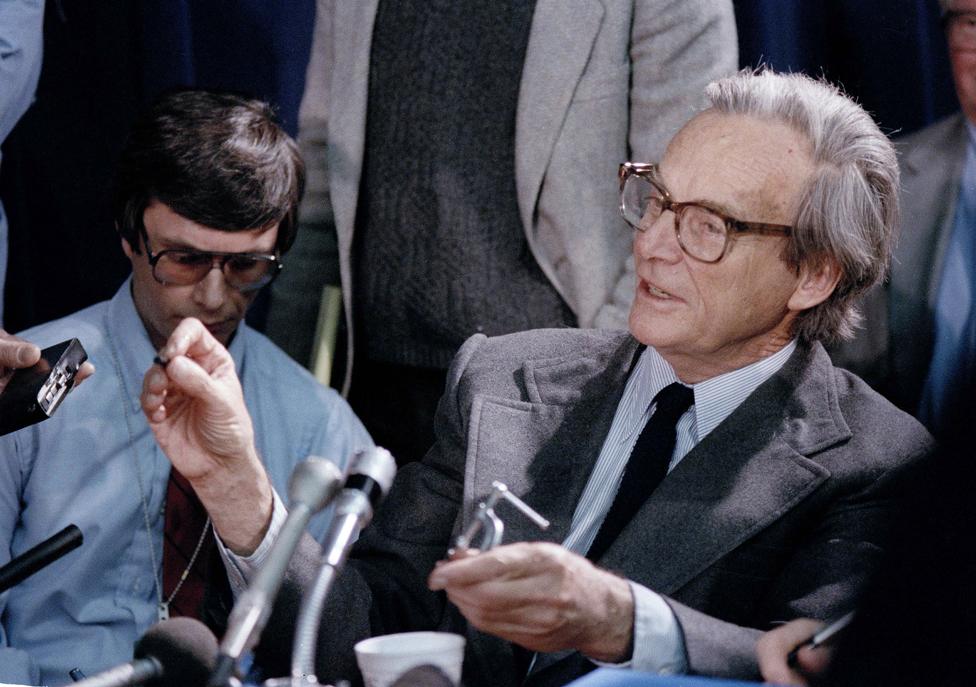
Within days, Reagan appointed the Presidential Commission on the Space Shuttle Challenger Accident, chaired by former Secretary of State William Rogers. The 14 members included legends like Neil Armstrong, the first moonwalker, Sally Ride, the first American woman in space, and Nobel physicist Richard Feynman, known for his no-nonsense approach.
Over five months, they held 35 sessions, many public, interviewing over 160 witnesses. Testimonies revealed a fractured communication chain: engineers’ warnings ignored by managers focused on schedules. Feynman, ever the showman, stole the spotlight in a February hearing by dipping an O-ring sample in ice water on camera, demonstrating how cold made it brittle and unable to rebound. “This is a clue,” he said dryly, underscoring the cold’s role.
The commission’s report, released June 9, 1986, was 256 pages of damning detail. It pinpointed the O-ring failure as the direct cause but excoriated NASA’s management for complacency, flawed risk assessment, and a culture where production pressures trumped safety. They noted 17 previous flights with O-ring damage, yet no fixes. Feynman’s personal appendix was brutal: “It appears that there are enormous differences of opinion as to the probability of a failure with loss of vehicle and of human life… For a successful technology, reality must take precedence over public relations, for nature cannot be fooled.”
Deeper Systemic Issues: A Culture in Need of Change
Beyond the technicals, the report exposed broader problems. NASA’s probability estimates for catastrophe varied wildly: managers claimed 1 in 100,000, engineers 1 in 200. This disconnect stemmed from a “silent safety program” where concerns weren’t escalated. Budget cuts post-Apollo forced reuse beyond design limits, and the shuttle’s “operational” status downplayed its experimental nature.
Political factors played in too, with NASA eager to maintain funding by portraying spaceflight as routine. The Teacher in Space push added urgency to launch despite risks. The commission recommended nine fixes, including redesigning the booster joints, independent safety oversight, and better communication channels.
Implementing Reforms: NASA’s Path to Recovery
The shuttle fleet grounded for 32 months while changes rolled out. The SRBs got a third O-ring, capture features to prevent joint rotation, and heaters for cold weather. Crews received partial pressure suits and personal escape packs, though a full bailout system came later. Launch criteria tightened: no go below 40°F without waivers.
NASA created the Office of Safety, Reliability, and Quality Assurance, reporting directly to the administrator. Risk management improved with failure modes analysis. When Discovery lifted off in September 1988, it marked a cautious return, with fewer launches annually. Yet, the 2003 Columbia disaster, caused by foam debris, showed cultural issues lingered, prompting another investigation and eventual shuttle retirement in 2011.
The Personal and Societal Impact: Turning Grief into Action
The families’ pain was immense. McAuliffe’s husband Steve remarried but honored her memory through education initiatives. The crew’s loved ones founded the Challenger Center for Space Science Education in 1986, now with over 40 learning centers teaching STEM to millions of kids annually. Scholarships and schools bear their names, like the McAuliffe-Shepard Discovery Center in New Hampshire.
Societally, Challenger dented public confidence in NASA, with approval ratings dropping temporarily. It sparked debates on space funding, with some calling for cuts, others for more to ensure safety. The tragedy influenced pop culture, inspiring books like “Truth, Lies, and O-Rings” by Allan McDonald, a Thiokol engineer who opposed the launch, and films like the 1990 TV movie “Challenger.”
On a psychological level, it reminded us of exploration’s perils. Kids who watched that day grew up with a more realistic view of science’s risks, perhaps inspiring safer innovations.
Legacy in the Stars: How Challenger Influences Space Today
Fast forward to 2025, and Challenger’s shadow looms over modern spaceflight. Private companies like SpaceX and Blue Origin prioritize iterative testing and failure learning, echoing commission lessons. NASA’s Artemis program, aiming for lunar return, incorporates redundant systems and rigorous reviews to avoid past pitfalls.
The disaster also advanced engineering ethics, with case studies in universities stressing whistleblowing and data-driven decisions. Environmentally, it highlighted booster pollution, spurring greener propellants research. Internationally, it fostered cooperation, as seen in the ISS, where risks are shared.
Wanna read more historical space events that took place before 2000’s?? Check out https://curio-nest.xyz/category/space-history … from moon landings to other milestones that defined an era.
Reflecting on Resilience: Why Challenger Still Matters
In the end, Challenger wasn’t just a loss, it was a catalyst for betterment. It taught that hubris in technology can be fatal, that listening to experts saves lives, and that perseverance through tragedy propels progress. As we eye Mars and beyond, remembering those 73 seconds keeps us humble and vigilant. The crew’s spirit lives on in every launch, a reminder that space is worth the risk when done right.
Common Questions
The primary cause was the failure of an O-ring seal in the right solid rocket booster due to cold temperatures, leading to a leak of hot gases that damaged the external fuel tank and caused the breakup.
The crew included Francis Scobee (commander), Michael Smith (pilot), Judith Resnik, Ellison Onizuka, Ronald McNair (mission specialists), Gregory Jarvis (payload specialist), and Christa McAuliffe (teacher in space).
It happened 73 seconds after liftoff.
NASA redesigned the booster joints, added safety oversight offices, improved communication between engineers and managers, and established stricter launch weather criteria.
Yes, including the Challenger Memorial at Arlington National Cemetery, the Space Mirror Memorial at Kennedy Space Center, and various schools and centers named after the crew.
It led to a more cautious approach to spaceflight, emphasized safety cultures in aerospace, and influenced designs in modern programs like Artemis and commercial space ventures.