Juno Mission, NASA’s Bold Journey to Jupiter
Introduction
Jupiter is the largest planet in our Solar System, a giant world made mostly of gas, wrapped in violent storms, crushing pressure, and a magnetic field so intense that it can damage spacecraft electronics. For a long time, astronomers could study Jupiter from Earth and from passing probes, but many big questions stayed open. What is hidden beneath those thick clouds? Does Jupiter have a solid core? How deep does the Great Red Spot go? Why are its auroras so powerful? And how did this giant planet help shape the early Solar System?
To answer those questions, NASA launched Juno, a mission designed to dive much closer to Jupiter than most earlier spacecraft. Instead of simply flying past, Juno would orbit the planet repeatedly, taking measurements of its gravity, magnetic field, atmosphere, polar regions, and deep interior. It was not just another planetary visit, it was a mission built to understand how a giant planet works from the inside out…
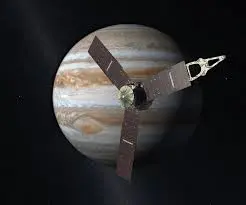
Juno became one of the most important Jupiter missions ever attempted. It helped scientists rethink old ideas about the planet, revealed strange weather patterns at the poles, and showed that Jupiter is even more complex than expected. In simple words, Juno did not just add details to a known picture, it changed the picture itself.
If you enjoy reading mission stories, Juno fits nicely beside deep space missions like Voyager 1, the close-up science of Parker Solar Probe, and exploration journeys such as Opportunity Rover. But Juno stands out because it focused on a giant planet that has influenced almost everything around it.
Why NASA sent Juno to Jupiter
Jupiter is not just big, it is important. Scientists often call it a kind of archive of the early Solar System. Because Jupiter formed very early and contains a huge amount of mass, understanding it can tell us a lot about how the Solar System itself formed. If researchers can learn what Jupiter is made of, how its interior is arranged, and how its atmosphere behaves, they can better understand the history of planets in general.
There were several major goals behind the Juno mission:
- Measure Jupiter’s composition, especially the amount of water and ammonia in its atmosphere
- Map the planet’s gravity field to learn about its deep interior
- Study Jupiter’s magnetic field in high detail
- Observe the auroras near the poles
- Understand how the planet formed and evolved over time
Earlier missions, especially the famous Galileo mission, had already taught scientists a lot. But Jupiter remained full of mysteries. Some models said it should have a compact solid core. Others suggested the core may have changed, mixed, or partly dissolved over time. Even basic questions about how deep Jupiter’s weather systems reached below the cloud tops were still being debated.
Juno was made to attack those questions directly. Instead of focusing only on images, it carried instruments that could sense what was happening below the visible clouds. That made it more like a planetary investigator than a simple camera mission.
What made Juno different from earlier missions
One of the most interesting things about Juno is that it was solar powered. That sounds normal at first, but Jupiter is far from the Sun, much farther than Earth. Sunlight there is much weaker, so generating enough power from solar panels is a serious challenge. Many people expected a spacecraft going that far to rely on a nuclear power source. Juno proved that carefully designed solar arrays could work even in the outer Solar System.
The spacecraft also followed a polar orbit. Rather than orbiting around Jupiter’s equator like many imagined, Juno passed over the poles. This was a smart choice. It allowed the spacecraft to study regions that had never been seen in such detail, especially the giant cyclones and powerful auroras near the poles. It also helped reduce the time Juno spent in the most dangerous parts of Jupiter’s radiation belts.
Even then, radiation was still a major problem. Jupiter has the strongest planetary magnetic field in the Solar System, and that field traps huge numbers of energetic particles. To survive, Juno’s most sensitive electronics were placed inside a special radiation vault made from titanium. Without that protection, the mission might have ended very quickly.
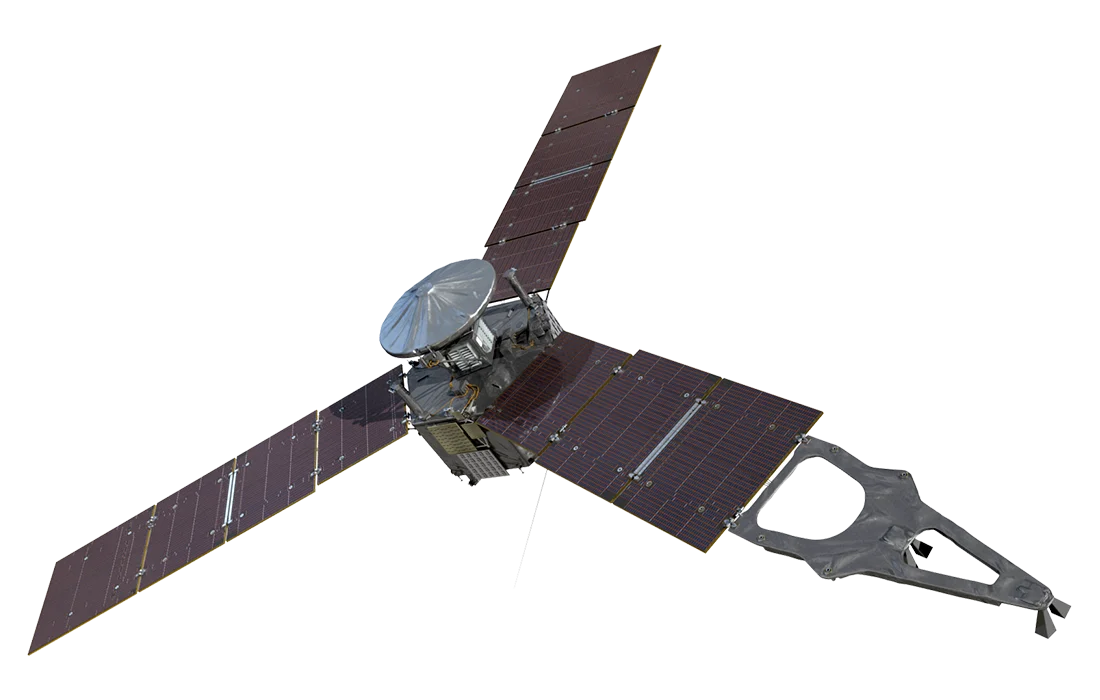
Juno also carried a mix of powerful instruments. Some studied particles, some measured radiation and magnetic fields, some looked at infrared emissions, and some sensed microwave signals coming from beneath Jupiter’s clouds. Together, they let Juno study both the planet’s surface appearance and its hidden structure. That combination was one of the mission’s greatest strengths.
The long trip to Jupiter
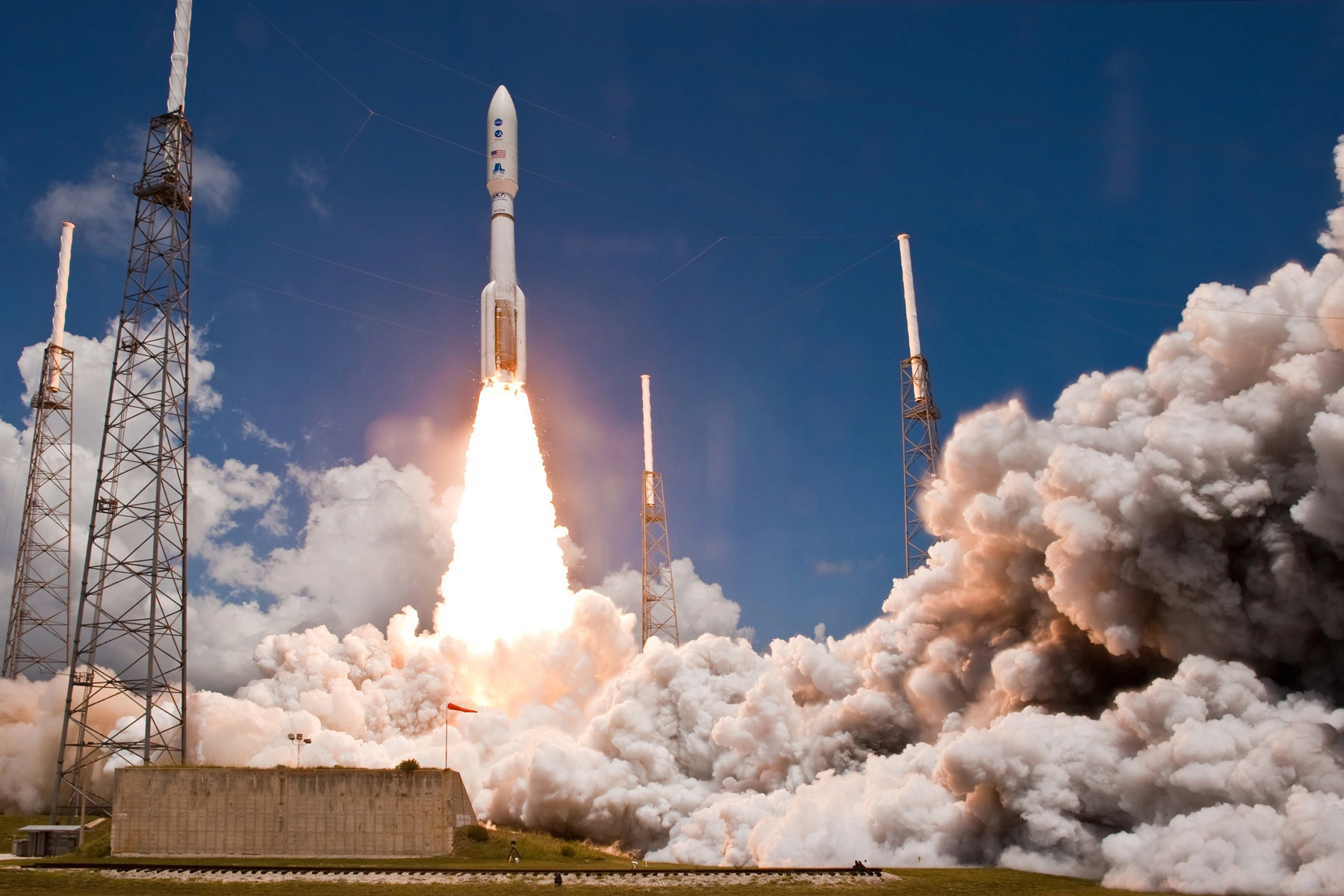
Juno launched on August 5, 2011, aboard an Atlas V rocket from Cape Canaveral. But going to Jupiter is not as simple as pointing a rocket outward and pressing go. Space missions often need gravity assists, careful timing, and years of cruise travel to reach their targets.
After launch, Juno traveled through the inner Solar System and later returned for an Earth flyby in 2013. This flyby gave the spacecraft extra speed by borrowing a little orbital energy from Earth. It was a clever and efficient move, and it helped set Juno on the right path toward Jupiter.
The cruise phase lasted nearly five years. During that time the team had to keep the spacecraft healthy, monitor its systems, and prepare for one of the most critical events of the whole mission, Jupiter orbit insertion. The distance alone made everything harder. Signals between Earth and Jupiter take a long time to travel, so engineers could not control the spacecraft in real time like a remote drone. Juno had to carry out key actions largely on its own.
That is one of the quiet heroic parts of space exploration. By the time engineers receive a signal from far away, the spacecraft has already done the thing, or failed doing it. Missions like Juno depend not only on hardware, but on trust in the planning.
Arrival at Jupiter and a tense orbit insertion
Juno arrived at Jupiter on July 4, 2016, and the spacecraft had to perform a major engine burn to slow down enough to be captured by Jupiter’s gravity. If that burn failed, Juno would have flown past the planet and the mission would have been in serious trouble. It was a tense moment for NASA, but the burn worked, and Juno entered orbit successfully.
That success was huge. Jupiter is not an easy place to visit. Its gravity is massive, its radiation is dangerous, and the spacecraft had to perform with extreme precision after years in space. Orbit insertion meant the mission had officially become a Jupiter science mission, not just a long cruise with hopes attached to it.
Originally, mission planners had hoped to place Juno into a shorter science orbit after arrival. However, concerns connected to the spacecraft’s propulsion system led the team to keep Juno in a longer orbit than first planned. Instead of seeing that as a disaster, the team adapted. Science continued, and Juno still produced remarkable results. In some ways, that flexibility helped show how strong the mission design really was.
The instruments that let Juno look beneath the clouds
Jupiter’s upper clouds are beautiful, but they can also be frustrating because they hide what is going on below. Juno’s instruments were chosen so the spacecraft could go beyond pretty pictures and actually investigate the planet’s deeper behavior.
- Microwave Radiometer, used to probe below the visible cloud tops and measure things like ammonia and water at different depths
- Magnetometer, used to map Jupiter’s magnetic field with extraordinary precision
- Gravity Science experiment, used to study how mass is distributed inside Jupiter by tracking tiny changes in the spacecraft’s motion
- JIRAM, an infrared instrument that helped study auroras and atmospheric structure
- Particle and plasma instruments, used to understand Jupiter’s energetic environment and auroral processes
- JunoCam, a visible light camera that captured dramatic public-friendly images of Jupiter
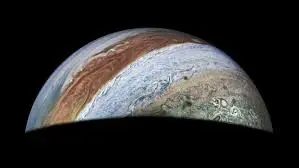
JunoCam is worth mentioning in a special way. It was not just for scientists, it also helped the public connect with the mission. Juno sent back jaw-dropping images of storms, swirling cloud belts, polar cyclones, and close passes over the giant planet. Those images made many people stop and stare… Jupiter no longer looked like a striped ball from a textbook, it looked alive.
The biggest challenges Juno had to survive
The Juno mission was full of difficulty. The first challenge was distance. Jupiter is far away, so the spacecraft had to operate reliably after years in space. Communication delays meant the spacecraft needed strong onboard autonomy. It had to make decisions and run sequences correctly without instant help from Earth.
The second challenge was radiation. Jupiter’s radiation belts can fry electronics, damage instruments, and slowly weaken spacecraft systems. That is why the radiation vault mattered so much. Even with shielding, the mission team had to plan very carefully to reduce exposure over time.
The third challenge was speed and gravity. Jupiter pulls hard. Juno had to enter orbit accurately, then keep flying through an environment where tiny navigation mistakes could grow into major problems. Each science pass had to be carefully timed and calculated.
Another difficulty was temperature. Spacecraft near Jupiter deal with cold conditions and weak sunlight, but some instruments and systems still create heat and must be managed carefully. Balancing power, warmth, and survival is always part of deep-space engineering.
And then there is the simple reality that nothing in space is simple. Small unexpected issues can grow into mission-shaping choices. Juno’s orbital plan changes showed that clearly. The team had to stay practical, calm, and flexible. That is one reason the mission is respected so much.
What Juno discovered about Jupiter’s interior
One of Juno’s most important achievements was changing how scientists think about Jupiter’s inside. Before Juno, many models imagined a more neatly structured planet, perhaps with a clear compact core buried beneath layers of hydrogen and helium. Juno’s gravity measurements suggested a messier reality.
Evidence pointed toward a diluted or fuzzy core, not a small sharply defined one. In other words, heavy material inside Jupiter may be spread out over a much larger region than expected. That was a big deal because it changed ideas about how Jupiter formed and how its interior evolved after formation.
If Jupiter’s core is diffuse rather than neat and compact, then giant planet formation may be more complex than older simplified models suggested. Some researchers proposed that a giant collision early in Jupiter’s history may have helped stir and spread heavy elements deeper inside the planet. Juno gave those ideas new weight.
This matters beyond Jupiter too. Astronomers study gas giants around other stars all the time. The more we understand Jupiter, the better we can interpret giant exoplanets elsewhere in the galaxy.
Jupiter’s weather turned out to be stranger than expected
Juno also transformed what we know about Jupiter’s atmosphere. From a distance, Jupiter looks like bands, spots, and storms. But Juno showed that the atmospheric structure is far more uneven and dynamic than many expected.
One key result involved ammonia. Scientists expected ammonia distribution to be more mixed and uniform in the upper atmosphere, but Juno found complex patterns that varied with latitude and depth. That suggested Jupiter’s atmosphere is not simply layered in a clean and predictable way.
The mission also found that many of Jupiter’s famous weather patterns extend much deeper below the cloud tops than previously known. The colorful belts and zones seen from telescopes are not just surface decorations. They are linked to deep atmospheric flows that reach far down into the planet.
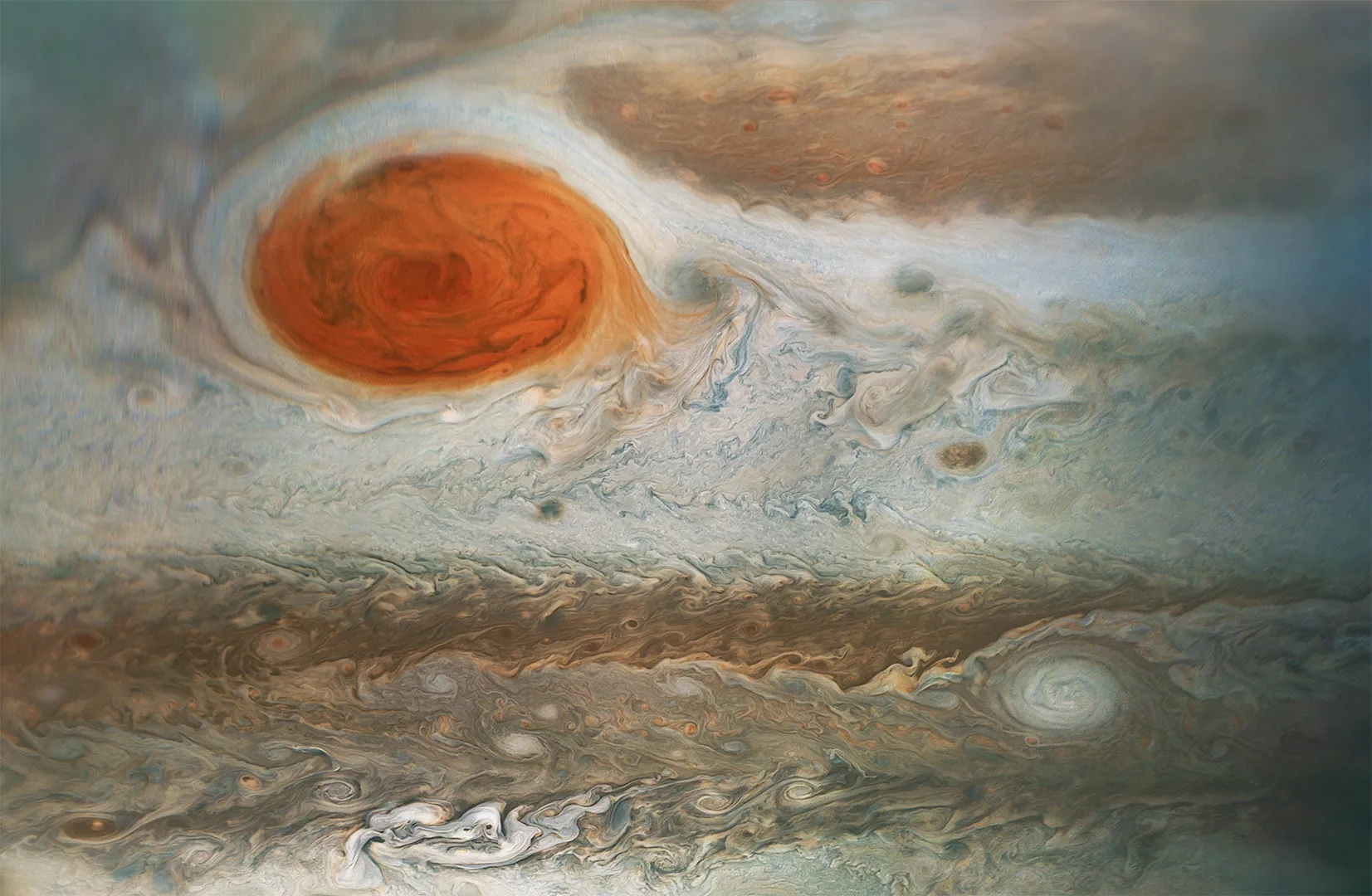
And then there is the Great Red Spot, the giant storm that has fascinated observers for centuries. Juno measurements showed that the storm extends significantly below the visible cloud layer. It is not an ultra-thin paint mark on the atmosphere, it is a deep and powerful structure.
Juno also helped reveal unusual lightning behavior and evidence for exotic forms of atmospheric processes, including ideas involving “mushballs,” hail-like objects made from ammonia and water mixtures. Jupiter keeps reminding us that planetary weather does not have to behave like Earth’s weather.
The poles, auroras, and giant cyclones
Before Juno, Jupiter’s poles had never been seen in such detail. What the spacecraft found was stunning. Around both poles were clusters of huge cyclones arranged in patterns, almost like planetary-scale storm mosaics. These were not tiny weather systems. Some of them were enormous, larger than many countries on Earth.
These cyclone groups were surprisingly stable over time. Instead of quickly breaking apart, they seemed to maintain organized patterns, though with movement and complexity. That opened new questions about how such systems form and remain stable in a fast-spinning giant atmosphere.
Juno also gave scientists a much better look at Jupiter’s auroras. Unlike Earth’s auroras, which are already beautiful and energetic, Jupiter’s are even more powerful and are driven by a more complicated system involving the planet’s magnetic field, charged particles, and the influence of its moons, especially Io.
What made the findings especially interesting is that Jupiter’s auroras did not always behave exactly as scientists predicted. Some of the processes appeared more chaotic and more variable. That was a reminder that even when we think we understand a planet broadly, details can still surprise us.
The magnetic field, one of Juno’s biggest science wins
Jupiter’s magnetic field is enormous, but Juno showed it is also oddly irregular. Instead of being smooth and simple, it has lopsided features and intense local variations. One particularly interesting region became known informally as the Great Blue Spot, a strong patch in the magnetic field near the equator.
This mattered because magnetic fields are generated inside planets by the movement of conductive material. By mapping Jupiter’s magnetic field in fine detail, Juno helped scientists learn more about what is happening deep inside the planet, where metallic hydrogen likely plays a key role.
In simple terms, Juno turned Jupiter’s magnetic field from a broad concept into a much richer map. That gave planetary scientists a better handle on the planet’s internal engine.
Juno’s extended mission and moon flybys
Juno’s mission did not stop after the first science phase. In its extended mission, the spacecraft’s orbit evolved in ways that allowed it to study parts of the Jovian system beyond Jupiter itself. That included close looks at some of the planet’s famous moons.
Juno made notable flybys of Ganymede and Europa, giving scientists fresh data on those worlds. Ganymede is especially interesting because it is the largest moon in the Solar System and has its own magnetic field. Europa is one of the most famous ocean-world candidates, with a hidden sea beneath an icy crust.
The mission also later performed close passes of Io, the most volcanically active world in the Solar System. Io is constantly shaped by tidal forces from Jupiter and neighboring moons, and it plays a major role in feeding charged particles into Jupiter’s magnetic environment. So even when Juno studied moons, it was still helping scientists understand Jupiter better.
That was one of the coolest parts of the extended mission… Juno kept finding new ways to stay useful.
Why the Juno mission matters so much
Juno matters because it answered big questions and created better ones. It improved our understanding of giant planet formation, deep atmospheres, magnetic fields, auroras, and planetary interiors. It also showed that Jupiter is less tidy, less predictable, and more dynamic than many models once assumed.
The mission also matters from a technology angle. Operating a solar-powered spacecraft so far from the Sun was an important engineering achievement. Surviving Jupiter’s harsh radiation environment for years was another. Juno proved that careful design can push missions into places once considered too risky.
There is also a broader scientific benefit. Giant planets influence the architecture of planetary systems. By studying Jupiter closely, scientists gain clues about worlds orbiting other stars. Many exoplanets discovered so far are large gas giants, so Jupiter serves as a kind of nearby laboratory for understanding them better.
Interesting facts about Juno
- Juno was the first solar-powered spacecraft to operate at Jupiter
- It entered orbit around Jupiter on July 4, 2016
- Its polar orbit gave humanity some of the best-ever views of Jupiter’s poles
- JunoCam helped turn raw science into stunning public images
- The spacecraft had to survive one of the harshest radiation environments in the Solar System
- Its gravity data suggested Jupiter may have a diluted, fuzzy core rather than a neat compact one
How the mission is expected to end
Space agencies have to think carefully about planetary protection. Some of Jupiter’s moons, especially Europa, are scientifically important because they may have environments where life could possibly exist in some form. NASA does not want an old spacecraft to accidentally crash into one of these worlds and contaminate it.
Because of that, Juno’s eventual end has been planned as a deliberate dive into Jupiter’s atmosphere. That way the spacecraft will burn up in the giant planet rather than risking an accidental impact with a moon later on. It is a dramatic ending, but also a responsible one.
There is something poetic about that. A mission sent to study Jupiter up close will one day become part of Jupiter’s atmosphere itself.
Final thoughts
The Juno mission is one of the clearest examples of why planetary exploration still matters. It took a world that seemed familiar from telescopes and old images, then showed that we had only been seeing the outer skin of the story. Beneath Jupiter’s clouds lies a planet with strange chemistry, deep weather, a complicated magnetic heart, immense polar storms, and a history tied to the birth of the Solar System.
Juno did not just visit Jupiter, it listened to it, weighed it, scanned it, mapped it, and challenged our assumptions about it. That is what makes the mission special. It turned Jupiter from a giant mystery into a giant mystery that we finally understand a lot better… but not completely.
And maybe that is the best result of all. Great missions answer questions, but they also make the universe feel bigger again.
Common Questions
The main goal was to understand Jupiter’s origin, structure, atmosphere, magnetic field, and deep interior. Juno was built to figure out how the giant planet formed and how it works inside.
Juno launched on August 5, 2011, and entered orbit around Jupiter on July 4, 2016.
Juno used a polar orbit, carried instruments that could probe below Jupiter’s clouds, and operated with solar power far from the Sun. It focused strongly on the planet’s deep interior and magnetic environment.
Juno data suggested Jupiter may not have a small sharply defined core. Instead, it may have a more diluted or fuzzy core, with heavy material spread over a wider region.
Yes. In its extended mission, Juno made important flybys of moons such as Ganymede, Europa, and Io, adding valuable science beyond Jupiter itself.
This is done to protect important moons like Europa from accidental contamination. Sending Juno into Jupiter is the safest and most responsible ending for the mission.