OSIRIS-REx: NASA’s Wild Asteroid Heist That Brought Bennu Back to Earth
Okay so, imagine this, NASA sends a spacecraft to a tiny black asteroid that looks like a floating pile of rubble, carefully reaches down, steals a bunch of ancient dust and rocks, and then throws that treasure back to Earth in a capsule like some cosmic delivery service… and it actually works. That’s basically the OSIRIS-REx mission in one sentence. But the real story is way more intense, way more nerdy, and honestly kinda emotional if you like space missions and human ingenuity.
OSIRIS-REx is one of those missions that sounds simple when you first hear it, “go grab a sample, bring it back”, but in reality it was like doing brain surgery while riding a bicycle on ice. The target asteroid Bennu is only about half a kilometer wide, has extremely weak gravity, spins, is covered in rocks the size of cars, and it is millions of kilometers away. One wrong move and the spacecraft could have slammed into a boulder, or drifted off into space forever. Yet NASA pulled it off. Twice, in a way, because the mission kept going after the sample return too..
In this article we’re gonna go deep into why OSIRIS-REx existed in the first place, how it launched, what it had to do at Bennu, the obstacles that nearly messed it up, and whether it was a success or failure. Spoiler, it was a huge success, but with some spicy problems along the way… Let’s go.
First, What Does “OSIRIS-REx” Even Mean?
NASA loves long acronyms, and OSIRIS-REx is one of the best and most ridiculous ones. It stands for:
Origins, Spectral Interpretation, Resource Identification, Security, Regolith Explorer.
Yeah, it’s a mouthful. But each part matters. “Origins” means studying the early Solar System, basically going back in time by examining primitive asteroid material. “Spectral Interpretation” means analyzing what Bennu is made of by looking at how it reflects sunlight at different wavelengths. “Resource Identification” is about learning what useful stuff asteroids contain, like water-bearing minerals or metals, which matters for future space industry. “Security” is about planetary defense, Bennu is classified as a potentially hazardous asteroid, so learning its properties improves impact predictions. “Regolith Explorer” is the sample part, regolith is the loose surface dirt and rocks on an asteroid.
So OSIRIS-REx was not just one mission goal, it was like five missions glued together, and somehow still stayed focused. Impressive.
Why Bennu? Why Not Some Other Rock?
 NASA
NASA
Bennu was chosen very carefully, not randomly. NASA wanted a near-Earth asteroid that’s reachable with the fuel budget, safe enough to operate near, and scientifically valuable. Bennu checks all those boxes, plus it has one extra big thing, it’s a carbon-rich asteroid, likely containing organic molecules and minerals that interacted with water early in Solar System history.
That matters because scientists think asteroids like Bennu could have delivered some of the ingredients for life to early Earth, like organics and water-bearing minerals. Not saying Bennu created life or anything, but it’s a time capsule. The stuff in Bennu has been sitting in cold storage for over 4.5 billion years, mostly unchanged since the Solar System formed. If you can hold a piece of that in a lab on Earth, you can test it with instruments far more powerful than what you can send into space.
Bennu is also interesting because it has a small chance, a very small chance, of impacting Earth in the late 2100s. NASA does not panic about it, but they do take it seriously. To predict an asteroid’s future orbit accurately, you need to understand things like its mass, density, surface properties, and how sunlight pushes it around. That sunlight push is called the Yarkovsky effect, and it’s one of those sneaky forces that makes asteroid predictions hard over long timescales. OSIRIS-REx helped a lot with that.
The Core Purpose, What NASA Wanted to Achieve
If you had to boil it down, OSIRIS-REx had three main “big picture” purposes:
1) Bring back a pristine sample. Not meteorites that got burned up and contaminated. A clean sample returned in a capsule, stored safely, measured carefully. NASA targeted at least 60 grams of material, which sounds small, but in science terms it’s a goldmine. And they ended up getting way more than that, which is kinda insane.
2) Map and understand Bennu in detail. Composition, surface geology, shape, rotation, mass, gravity field, thermal properties, regolith behavior, everything. That helps science, and it helps planetary defense.
3) Improve asteroid impact risk modeling. By measuring Bennu directly, NASA could refine long-term predictions and test models of how asteroid orbits shift over decades.
There were also “bonus goals” like documenting what makes Bennu dark, how it sheds particles sometimes, and what the surface looks like at centimeter scale. Some of those became bigger than expected because Bennu turned out to be weird…
Launch Day, How the Journey Started
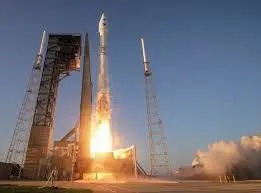
OSIRIS-REx launched on September 8, 2016, from Cape Canaveral in Florida. It rode an Atlas V rocket (the 411 configuration), which is one of those classic reliable rockets NASA used for a lot of missions. The launch window was important because the spacecraft needed the correct trajectory to meet Bennu at the right time with minimal fuel use.
After launch, the spacecraft separated from the rocket and started deploying its systems, solar panels, communication antennas, and checking instrument health. Early mission phases are always like a nervous checklist marathon. You are basically asking, “did the spacecraft survive the shaking and vibrations”, “is it alive”, “can it talk”, “are the computers okay”. Thankfully, OSIRIS-REx behaved.
But the path to Bennu was not direct. Space missions often do gravity assists to save fuel, and OSIRIS-REx used Earth for that trick.
The Cruise Phase and Earth Gravity Assist
Instead of blasting straight to Bennu with a massive burn, OSIRIS-REx did a long cruise with course corrections and a key Earth flyby. On September 22, 2017, it flew past Earth for a gravity assist, using Earth’s gravity to bend its trajectory and boost it into the plane of Bennu’s orbit. This is like a perfectly timed slingshot, you “steal” a tiny bit of Earth’s orbital energy and redirect yourself. It’s not magic, but it feels like it..
During the cruise, the mission team also checked and calibrated instruments. OSIRIS-REx wasn’t just a sample vacuum cleaner, it was also a serious science observatory.
The Spacecraft, What Was On It?
OSIRIS-REx carried several main instruments, and each had a job:
OCAMS (OSIRIS-REx Camera Suite), multiple cameras for mapping, navigation, and close-up imaging.
OLA (OSIRIS-REx Laser Altimeter), a lidar system that measured distances and helped build 3D maps.
OVIRS, a visible and infrared spectrometer, used to analyze surface composition.
OTES, a thermal emission spectrometer, used to measure mineral signatures and temperature behavior.
REXIS, an X-ray imaging spectrometer (built with student involvement), to study elemental composition by measuring X-ray fluorescence.
And then the star of the show:
TAGSAM, the Touch-And-Go Sample Acquisition Mechanism. This was basically a robotic arm ending in a sampling head. The plan was to briefly touch the surface, fire a burst of nitrogen gas, stir up regolith, and capture it in the head. No drilling, no scooping for minutes, just “touch, puff, grab, retreat”. Very fast, very delicate.
Arrival at Bennu, The “Oh No” Moment
 NASA
NASA
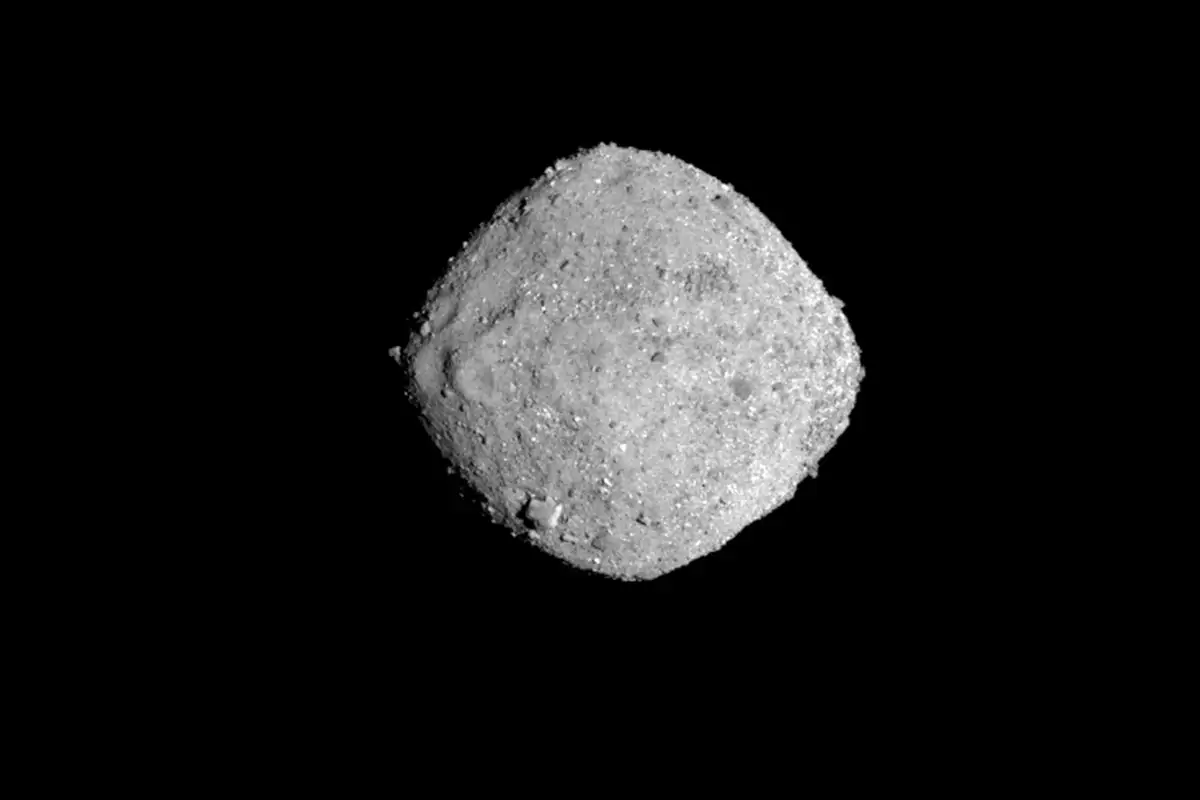
OSIRIS-REx arrived at Bennu on December 3, 2018. And almost immediately, Bennu started surprising people. Before arrival, scientists expected Bennu to have some boulders, sure, but also smooth “beach-like” patches of fine regolith where sampling would be easy.
Instead, Bennu looked like a wrecking yard. It was covered in rocks, chunky boulders, jagged edges, and rough terrain almost everywhere. The “smooth” areas they expected were tiny, and sometimes not smooth at all. This was a big obstacle because TAGSAM needed a relatively safe area, and the spacecraft had to do precision navigation in extremely low gravity. There’s no stable thick atmosphere, no easy hovering, and you can’t just “land” like on Mars. You are basically balancing in a gravitational field that barely exists.
Bennu also did something else that made scientists go “wait what”, it occasionally ejected small particles into space. Like it was spitting rocks. Some of those particles went into orbit temporarily around Bennu then fell back. This was not expected. It wasn’t catastrophic for the spacecraft, but it added risk and mystery. What causes it, thermal cracking, micro-meteor impacts, some electrostatic stuff? Likely a combination. But still, Bennu was clearly more active than predicted.
Mapping Bennu, Building a 3D World Model
To sample safely, the team had to map Bennu down to the level of individual rocks. That took months. The spacecraft flew in different patterns around the asteroid, scanning it, taking high-res images, and building a detailed shape model. This is the part people don’t appreciate enough, because it’s slow and methodical, but it’s the foundation of success.
Scientists and engineers used the mapping to select candidate sites. Initially they narrowed it to a few places with names like Nightingale and Osprey, because mission teams love bird names. Nightingale eventually became the primary sample site.
But Nightingale was not some giant safe football field. It was a small crater area with hazards nearby. The “safe zone” was actually pretty tiny when you consider the spacecraft had to hit it with extreme accuracy. If the spacecraft drifted off by even a few meters, it could have collided with rocks.
The Biggest Obstacle, Navigation in Microgravity
Here’s a thing people might not realize, flying near a small asteroid is harder than orbiting a planet. On Earth, planes fly because air provides lift. On Mars, landers use atmosphere and parachutes (and rockets). Near Bennu, there’s almost nothing pulling you down. The gravity is so weak that if you jump off Bennu, you could drift away like a balloon, assuming you could even jump in the first place.
That means the spacecraft’s orbit and descent had to be super controlled. Thruster firings could push it too much. Solar radiation pressure could slowly nudge it. Even tiny errors in estimating Bennu’s gravity field could add up. So NASA developed and used a system called Natural Feature Tracking, which basically let the spacecraft compare real-time camera images with a stored map of surface features. It was like facial recognition but for boulders. This allowed the spacecraft to correct its path during descent, in real time, to avoid hazards and hit the target.
Natural Feature Tracking ended up being mission-critical. Without it, sampling at Nightingale would have been way too risky. This was one of those “obstacle turned into innovation” situations, where the problem forced smarter tech.
Rehearsals, Because You Do Not Get a Second Chance (Usually)
Before the real sampling, OSIRIS-REx did rehearsal descents. These were like practice runs where it approached the surface, did key maneuvers, then backed away before touching. The team used these rehearsals to test navigation, timing, and confidence in the spacecraft’s ability to reach the site.
Even rehearsals were stressful. A small mistake could have ended the mission early. But the rehearsals improved the process and helped confirm the surface conditions in more detail. Bennu was still rocky and dangerous, but the team felt ready.
The Touch-And-Go Event, The Moment Everyone Held Their Breath
 NASA
NASA
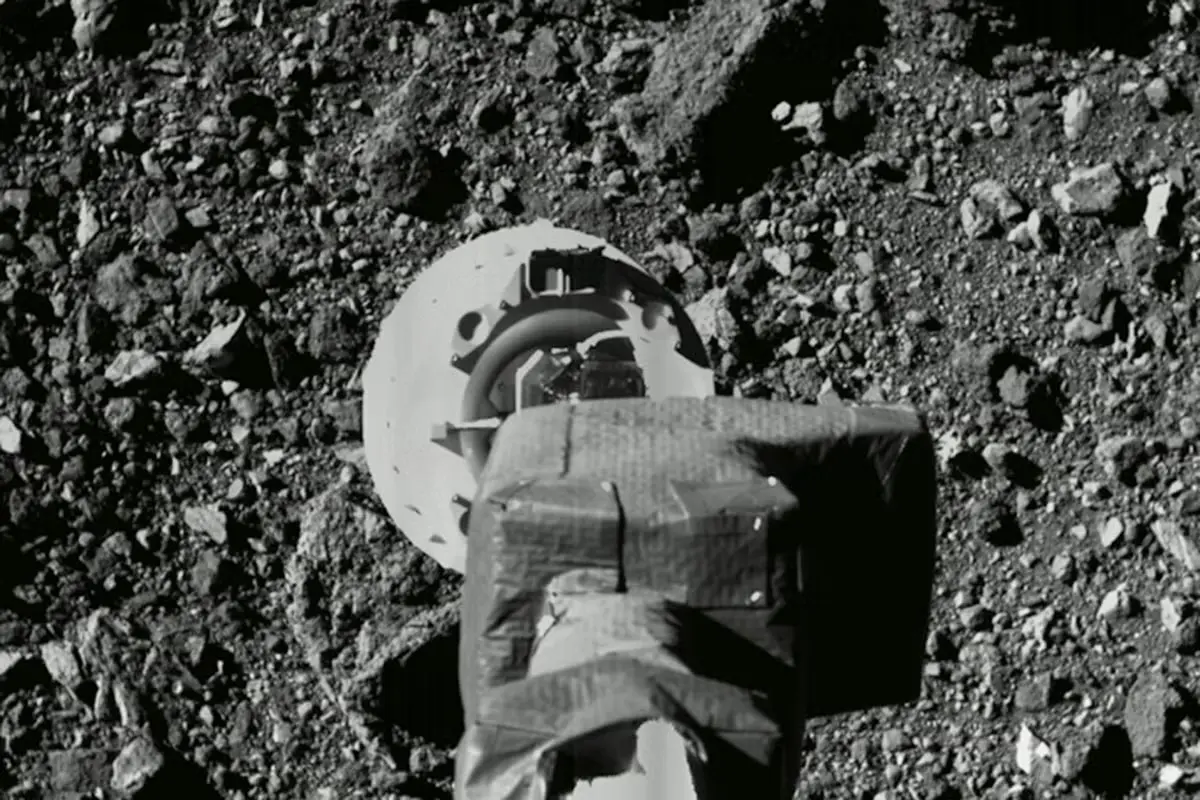
On October 20, 2020, OSIRIS-REx performed the main event, the sample collection. This is the famous TAG, Touch-And-Go. The spacecraft descended slowly toward Nightingale, guided by Natural Feature Tracking. It was basically aiming for a small safe patch inside a crater, while rocks and hazards surrounded it like teeth.
When the sampling head touched the surface, it fired a burst of nitrogen gas. That gas stirred up regolith, and the sampling head collected material. Then the spacecraft fired thrusters to back away quickly. Total contact time was just seconds. Fast, clean, and hopefully effective.
But something surprising happened. The surface at Nightingale behaved more like a fluid than solid ground. Instead of a hard touch and bounce, the sampling head sank into Bennu’s regolith more than expected. The spacecraft still backed away safely, but it showed Bennu’s surface was extremely loose, almost like a ball pit of dusty pebbles. If it had stayed longer, it could have sunk deeper, which sounds funny until you realize that could have caused damage.
NASA then did checks to see if material was collected. They used images and spin tests to estimate mass. And then they saw it, the sampling head had so much material that pieces were leaking out, and the lid couldn’t close properly due to rocks jammed in the mechanism. That is a very real obstacle nobody wanted. Because if you leak too much, you might lose the sample during the cruise back to Earth.
The team reacted quickly. Instead of doing the planned extra sampling attempt (they had fuel and nitrogen for more tries), they decided to stow the sampling head as soon as possible into the return capsule. This stowing operation was delicate, and the risk was, if the head was not seated properly, it could fail to lock, or lose material. Thankfully, the stow worked. Some material likely escaped before stow, but there was still plenty remaining. NASA later confirmed they exceeded the minimum sample requirement by a lot. Like, a lot a lot.
So yeah, the mission’s biggest “oops” became a good problem. Too much sample is better than too little… still stressful though.
Leaving Bennu and Heading Home
After securing the sample, OSIRIS-REx spent some more time at Bennu for final observations and then began its return journey. It departed Bennu in May 2021 and started the long cruise back toward Earth. During cruise, the spacecraft maintained its health, navigation, and communications, while the sample sat inside the return capsule like a precious time capsule from 4.5 billion years ago.
Return missions are sometimes called “boring” because there’s less action than arriving and sampling, but honestly it’s a different kind of tension. If something goes wrong now, you could lose everything after years of work. And you can’t just turn around and grab another sample easily, you already left the asteroid.
Sample Return, The Delivery to Earth
 NASA
NASA
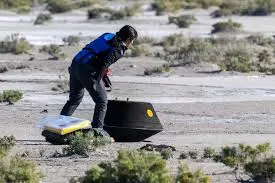
On September 24, 2023, OSIRIS-REx arrived back at Earth for the big drop. The spacecraft released the Sample Return Capsule, which entered Earth’s atmosphere and landed in Utah at the Utah Test and Training Range. The capsule used a heat shield to survive reentry and parachutes to land gently. This part looks like a classic space mission moment, like Apollo capsule returns, just smaller.
Recovery teams collected the capsule and transported it for analysis. A huge priority was keeping contamination low. Scientists want to study the sample in a controlled clean environment, because Earth’s atmosphere, microbes, and moisture can change or contaminate certain materials. The sample is precious because it can answer questions meteorites can’t answer cleanly, especially when it comes to volatile compounds and organics.
And here’s a fun part, early on, even before fully opening the main container, scientists found some fine dust and grains around the capsule hardware, which meant Bennu material was already leaking in small amounts inside. Again, stressful, but also proof the mission got a lot of sample.
Another Obstacle, Opening the Sample Hardware (Yes, Even That Was Hard)
People think the story ends when the capsule lands. Nope. There were some real challenges in the lab too. Some fasteners and parts of the sample container were difficult to open using the planned tools. This is not “space failed”, it’s more like “engineering reality is annoying”. They had to design or adapt tools carefully to open it without damaging the sample or contaminating it. Eventually they succeeded and continued the careful extraction.
Once enough sample was measured and cataloged, NASA confirmed the returned mass was well above the minimum requirement, and later announcements indicated the mission returned over a hundred grams of material overall. That’s massive for a sample return mission. More sample means more science, and it means more can be stored for future generations too. Some Apollo samples are still studied today with new tech, so Bennu samples might still be teaching humans in 2070 or 2100. Crazy thought..
What Did We Actually Bring Back? The Science Value
So what makes Bennu material special? For one, Bennu is carbon-rich, meaning it contains a lot of carbon-based compounds, including organic molecules. Organic does not mean living, it just means carbon chemistry. But carbon chemistry is the foundation of life, so understanding organics in primitive asteroids helps us understand how the ingredients for life might have been distributed in the early Solar System.
Another key is water-altered minerals. Many carbonaceous asteroids show evidence that their parent bodies once had liquid water inside, long ago. Water interacts with rock and creates certain clay-like minerals called phyllosilicates. Finding and studying those minerals tells scientists about early water in the Solar System, and how common it was.
And because the sample was returned directly, scientists can do things like isotope analysis, microstructure imaging, and chemical mapping with ultra-sensitive lab instruments. Some of those instruments are too big, too power hungry, or too delicate for spacecraft. On Earth, you can use them freely and cross-check results between labs worldwide.
So OSIRIS-REx is basically a delivery of raw early Solar System data, not as digital numbers but as real physical material. That’s why sample return missions are so valuable, even though they’re hard and expensive.
Mission Timeline Quick Map (So You Don’t Get Lost)
2016 Sep 8, Launch from Cape Canaveral.
2017 Sep 22, Earth gravity assist.
2018 Dec 3, Arrival at Bennu.
2018 to 2020, Mapping, site selection, rehearsals.
2020 Oct 20, TAG sample collection at Nightingale.
2021 May, Departure from Bennu.
2023 Sep 24, Sample capsule returned to Earth, landed in Utah.
That’s the core story. But the spacecraft itself did not retire after dropping the capsule. It kept going..
Success or Failure? Let’s Be Honest
If you judge by mission goals, OSIRIS-REx was a major success. It returned a large amount of asteroid material safely to Earth, mapped Bennu in unprecedented detail, improved impact risk knowledge, and delivered tons of scientific data. It also proved new navigation techniques like Natural Feature Tracking around a small body, which is useful for future missions, including potential asteroid deflection missions.
Were there obstacles and near-misses? Yes. Bennu being boulder-covered was a huge obstacle. The sampling head getting jammed open by rocks was another. The surface being so loose was an unexpected behavior that could have become dangerous. The particle ejection events were another surprise. But the mission team handled these challenges in a very professional way, and adapted quickly. That adaptability is part of why this mission is celebrated.
So no, it was not a failure. Not even close. It was one of NASA’s coolest sample return missions ever, and it set the bar high.
Planetary Defense, Why This Mission Matters for Earth Safety
Let’s talk “Security” in the acronym, because it’s not just a marketing word. Bennu has a small probability of impacting Earth in the far future, so scientists want precise predictions. Predicting impacts decades ahead is tricky because small forces add up. The Yarkovsky effect, sunlight heating and cooling the asteroid causing tiny thrust, can shift orbit over time. OSIRIS-REx measured Bennu’s physical properties in detail, like shape, rotation, mass, surface roughness, and thermal behavior. That means models of Yarkovsky and long-term orbit evolution can be tested and improved.
Also, understanding Bennu’s structure matters. Bennu is a rubble pile, basically a loose collection of rocks held together by weak gravity and maybe a bit of cohesion. If in the future humans needed to deflect a rubble pile asteroid, the strategy might differ compared to a solid rock. A kinetic impactor might behave differently, a nuclear standoff might behave differently, even a slow “gravity tractor” might have different effects. OSIRIS-REx data is a big step toward understanding that reality.
Resource Identification, The “Space Mining” Angle
Now for the part that sounds like sci-fi but is increasingly real. Asteroids contain resources, water, metals, carbon compounds. Water is especially important because it can be used for life support, radiation shielding, and even split into hydrogen and oxygen for rocket propellant. If you can get water in space, you reduce the need to launch it from Earth, which is expensive.
OSIRIS-REx was not a mining mission, but it helped map what kind of “resources” carbonaceous asteroids might contain, and how they are distributed. It also taught us a big lesson, asteroid surfaces can be more chaotic than expected, so any future mining tech must handle boulders, dust, and unpredictable regolith behavior. Bennu is like a warning sign that says, “don’t assume it’s a smooth sand beach”.
The Mission Continued, OSIRIS-APEX and Apophis
 NASA
NASA
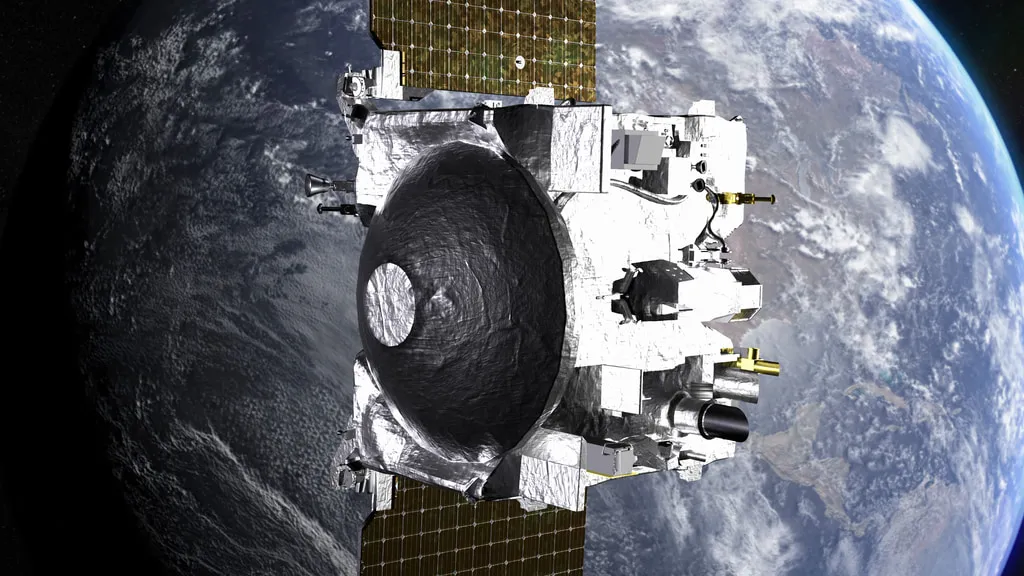
After dropping the sample capsule, the spacecraft did not have the fuel to return to Bennu, and there was no need anyway. So NASA approved an extended mission, re-targeting the spacecraft to another famous near-Earth asteroid, 99942 Apophis. The spacecraft’s new mission is often referred to as OSIRIS-APEX.
Apophis is interesting because it will fly very close to Earth in 2029, close enough to be visible to the naked eye from some locations. That close pass will change Apophis’s orbit and may also cause physical changes to the asteroid due to Earth’s tidal forces, like surface shaking, landslides, or regolith movement. Having a spacecraft there to observe before and after the close approach is pure science gold.
So OSIRIS-REx became more than “just” a sample return mission. It turned into a long-term asteroid explorer, using the same hardware to squeeze more value out of a successful spacecraft. NASA loves doing this when possible, and honestly, it’s smart. The spacecraft already exists, already proven, so why not keep it working..
What Was the Hardest Part? If I Had to Pick One
In my opinion, the hardest part was the combination of precision navigation and hazardous terrain. Bennu forced the mission team to be insanely accurate. It wasn’t like landing on a big planet where you have wide open plains. It was like trying to touch a moving spinning rock, while avoiding boulders, with gravity so weak that small thruster errors could send you drifting. Natural Feature Tracking was not just a fancy tool, it was the difference between success and a crash.
Second hardest part, the sample stow problem. When you get “too much” sample and it jams the mechanism, you don’t get to celebrate, you panic a bit. The team had to improvise within safety margins and make fast decisions. They did it right. That’s why the sample made it home.
Why This Mission Will Be Remembered
OSIRIS-REx will be remembered for at least five reasons:
1) It returned a large carbon-rich asteroid sample to Earth. That alone is historic.
2) It changed our assumptions about asteroid surfaces. Bennu was rougher and weirder than models predicted.
3) It advanced precision navigation near small bodies. Natural Feature Tracking is a huge contribution.
4) It improved planetary defense science. Better orbit and hazard modeling matters for the future.
5) It kept going into an extended mission. Turning a successful mission into an even larger science campaign is just awesome.
Also, there’s a human side, the mission took years, from launch to sample return it was about seven years. Many people spent a chunk of their life working on it. Some students who helped build instruments likely became full engineers by the time the sample landed. That time scale is wild when you think about it..
Common Questions
Not like a normal landing. It did a Touch-And-Go, it touched the surface for seconds, fired nitrogen gas, collected material, then backed away fast. It was never meant to stay parked there.
NASA’s minimum goal was at least 60 grams, but the mission returned well above that. The sampling head was so full it leaked a bit before stow, which is a funny problem to have, but still nerve-racking.
Telescopes can tell a lot, but they can’t replace lab analysis. With a sample you can do isotope tests, microscopic structure studies, and chemistry mapping with instruments too big to fly in space. It’s like comparing a photo to holding the real object.
Two big surprises, Bennu was way more boulder-covered than expected, and it sometimes ejected particles into space. Also the surface was super loose, like it didn’t “push back” much during sampling.
No immediate danger. Bennu has a small impact probability in the late 2100s, but it’s low. The mission improved long-term predictions and helped science for planetary defense anyway.
After releasing the sample capsule, the spacecraft continued into an extended mission toward asteroid Apophis (often called OSIRIS-APEX). The goal is to observe Apophis around its close Earth flyby in 2029.
Yeah, many points. Navigation near Bennu could have caused a crash, sampling could have missed or hit rocks, the sample container could have failed to stow, and reentry could have gone wrong. It’s kind of amazing it all worked as well as it did.
Final Thoughts, A Mission That Feels Like Sci-fi But It’s Real
OSIRIS-REx is one of those missions that makes you feel like humans are actually capable of insane precision and patience. We sent a robot millions of kilometers away, taught it to recognize boulders like landmarks, made it gently tap an asteroid, steal a pile of ancient dirt, and then mail that dirt back to Earth on a precise date. That’s not normal. That’s peak human engineering.
And the best part, the science is just getting started. Those Bennu samples will be studied for decades, maybe longer. Every time a new instrument technique is invented, scientists can take a tiny grain and learn something new about the early Solar System, about organics, about water history, about how rubble-pile asteroids form and evolve. So in a way, OSIRIS-REx is not finished at all, it just shifted from “space mission” to “lab mission”… and both are awesome.
If you want to dig deeper later, you can check NASA’s official OSIRIS-REx mission pages and the published papers from the mission team. But even if you just remember the headline, “NASA brought Bennu to Earth”, that alone is enough to appreciate how wild this mission was..