Tianwen-1 Mars Mission, China’s First Mars Orbiter, Lander, and Rover
Introduction
If you have heard the name “Tianwan 1” in a comment section or a short video, you are not alone. Many people type it that way, but the official mission name is Tianwen-1. It was China’s first independent mission to Mars, and it was not a small step. Tianwen-1 combined an orbiter, a lander, and a rover in a single launch, aiming to enter Mars orbit, land safely, and then drive and study the planet’s surface.
This mission mattered for two reasons at once. First, it was a technology test at a very high level, deep space navigation, Mars orbit insertion, entry, descent, landing, surface operations, and long distance communications. Second, it was a science mission, built to study Mars geology, climate, and signs of water related processes, including what may be hidden under the surface.
Tianwen-1 launched in 2020 during the Mars launch window (a time when Earth and Mars are positioned well for travel). It arrived at Mars in early 2021, and later delivered the Zhurong rover to the surface. The rover explored the landing region and returned new data, while the orbiter continued doing broader observations from above. Together, they helped expand what we know about Mars and also proved China can run complex interplanetary missions… which is not easy at all.
What does “Tianwen” mean?
“Tianwen” is usually translated as Questions to Heaven, a reference to a classical Chinese poem associated with questioning the mysteries of the universe. It fits the vibe of a Mars mission perfectly, because Mars is basically a planet full of questions. Was there water, for how long, where did it go, did Mars ever have conditions friendly to life, what is happening in the subsurface today, and why did Mars become so different from Earth?
The “1” indicates it is the first mission in that Tianwen series, not the first Chinese space mission overall. It is more like “the first Mars mission under this program name.”
Quick mission snapshot
Before we go deep, here is the mission in plain terms, no heavy math.
- Launch vehicle, Long March 5 (Chang Zheng 5), China’s heavy lift rocket.
- Spacecraft stack, Orbiter + lander + Zhurong rover, all launched together.
- Main goals, orbit Mars, map and study the planet, land safely, operate a rover on the surface.
- Landing region, Utopia Planitia (a large plain in the northern hemisphere).
- Science themes, geology, surface materials, climate and weather, water ice clues, subsurface structure.
One detail that makes Tianwen-1 special is that it tried “orbit plus landing plus roving” in the very first attempt. Many programs did it in steps, first orbiters, then landers, then rovers later. Doing it together increases complexity, and also increases the reward if it works.
Why China went to Mars
People sometimes ask, why Mars, why not the Moon only? The Moon is closer and cheaper, sure, but Mars is the next big laboratory. It is close enough to reach with current rockets, and it has a history that looks like it once had rivers, lakes, and maybe even an ocean, depending on which era you are talking about.
There are a few overlapping reasons Tianwen-1 happened:
1) Big science questions
Mars preserves ancient geology better than Earth in many ways, because Earth’s surface is constantly recycled by plate tectonics and erosion. On Mars, some regions are like a time capsule. Studying minerals, rock shapes, and layers can hint at how water moved, how climate changed, and what conditions were like billions of years ago.
2) Building deep space capability
Mars missions are a systems test for spaceflight. You must navigate for months, manage power and thermal conditions, communicate across huge distances, and then perform a high risk landing sequence with limited real time control (because radio signals take minutes to travel). Success means you can do even harder missions later.
3) Long term exploration plans
China has been building step by step in space, from crewed missions and space stations to lunar exploration. Mars is a natural next target. A successful orbiter helps with future landing site planning, and a rover proves surface operations, which helps future sample return ambitions too.
The launch, Long March 5 and why it matters
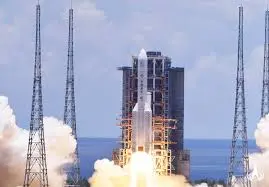
Tianwen-1 launched on Long March 5 from Wenchang Space Launch Site in Hainan, China. Long March 5 is important because it represents China’s move into heavy lift capability, similar in category to rockets that can push large spacecraft beyond Earth orbit.
For interplanetary missions, mass matters. You need fuel for trajectory corrections, a heat shield and landing system if you want to land, a robust communications setup, and power systems that can handle long operations. A smaller rocket forces compromises. A heavy lifter gives you room to carry more capability and redundancy.
Long March 5 itself had a public history with both success and setbacks in its earlier years, so Tianwen-1 also had a “prove the rocket” energy around it. Interplanetary missions are not the place you want surprises. You need the rocket to be stable, predictable, and well understood.
Mission architecture, three spacecraft roles in one
Tianwen-1 is best understood as a team with different jobs, one stays above Mars long term, one is built to survive entry and landing, and one is built to explore locally.
The orbiter
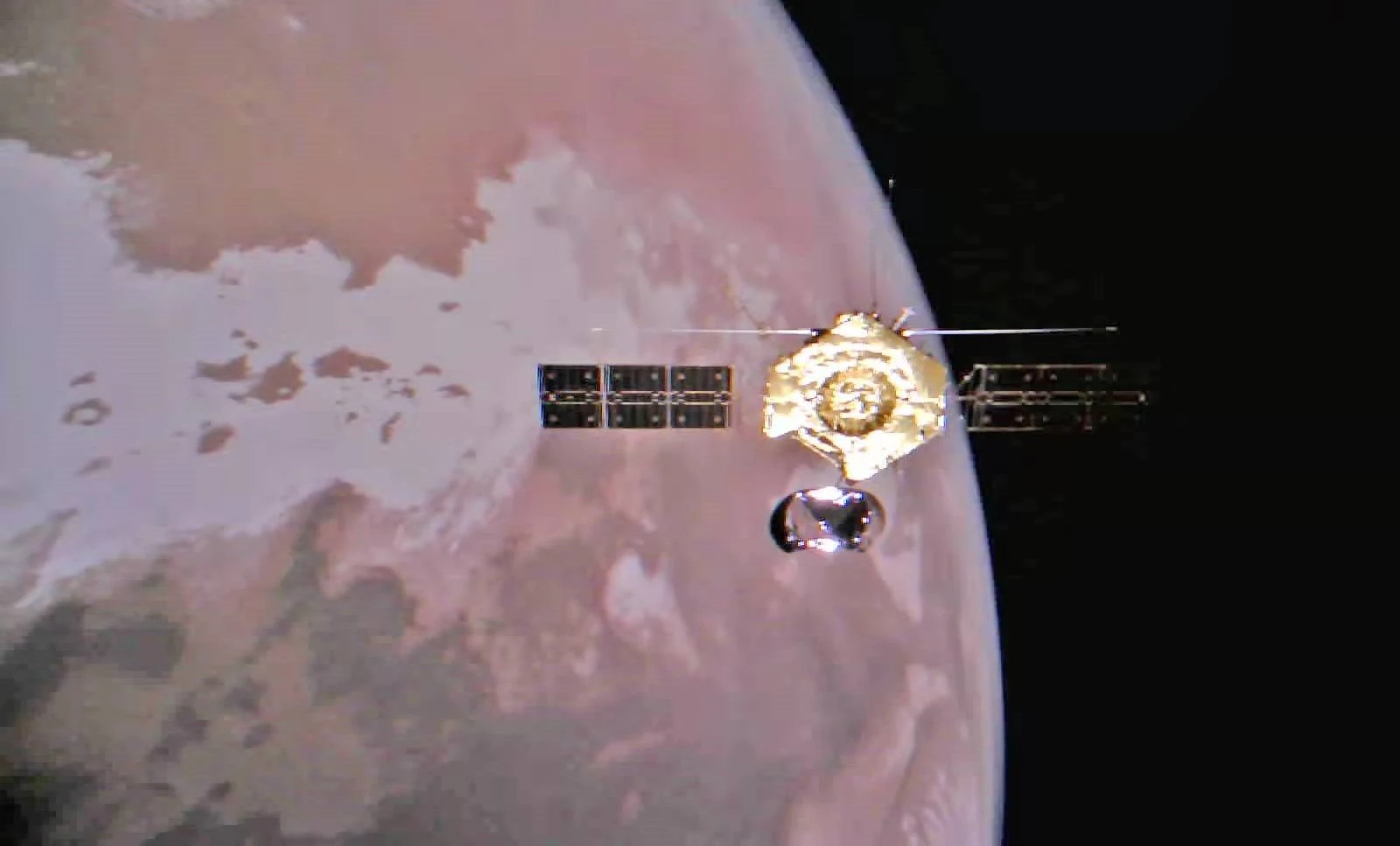
The orbiter is the long distance observer. It carries instruments for remote sensing, meaning it studies Mars from above. It can map terrain, analyze mineral signatures, watch dust storms, and also act as a communications relay for the rover.
Orbiters are underrated. A rover can do detailed science at one spot, but an orbiter can connect the dots across the entire planet.
The lander
The lander is basically the delivery system that gets the rover to the ground alive. Mars landing is hard because the atmosphere is thin. It is thick enough to heat you up and cause intense forces, but thin enough that parachutes alone are not enough. So landers combine heat shields, parachutes, and powered descent.
The rover, Zhurong
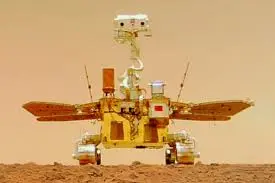
Zhurong is the explorer on wheels. Its mission is local detail, measuring soil and rock properties, imaging the surroundings, and collecting data about surface materials and subsurface structure using instruments like ground penetrating radar. A rover turns “Mars is a dot on a screen” into a place with texture, layers, and real environmental conditions…
Traveling to Mars, the cruise phase explained simply
After launch, Tianwen-1 entered a trajectory that would intersect Mars months later. This is not like driving straight to a city, it is more like throwing a ball so that it arrives at the same spot where another moving target will be later. Earth and Mars are both orbiting the Sun, so the spacecraft must be timed and aimed for a future meeting point.
During cruise, a spacecraft does more than “coast.” It performs trajectory correction maneuvers, checks its systems, updates navigation solutions, and prepares for Mars arrival. Many things can nudge the path slightly, small engine performance differences, solar radiation pressure, tiny measurement errors, and even subtle timing offsets.
To handle that, teams track the spacecraft by radio, measure its velocity via Doppler shift, and calculate correction burns. These burns are usually small compared to the launch, but they are crucial. A tiny miss at Earth can become a huge miss at Mars.
Mars orbit insertion, slowing down at the right moment
Arriving at Mars is not the finish line. If you fly past Mars at interplanetary speed, you will just keep going around the Sun. To be captured into orbit, the spacecraft must slow down relative to Mars at exactly the right time. That is done by firing its engine during Mars approach, a maneuver called Mars Orbit Insertion.
The difficulty is that this burn happens far away, with delayed communication. Controllers can plan it and monitor telemetry, but the sequence must be highly autonomous. The spacecraft has to point correctly, fire for the correct duration, and then stabilize itself. If the burn is too weak, you might miss capture. If too strong, you might enter the atmosphere or end up in an unusable orbit.
Tianwen-1 successfully entered Mars orbit, which already counts as a major win. After that, the mission spent time adjusting its orbit and scouting the landing area before attempting the surface phase.
Choosing Utopia Planitia, why land on a “plain”?
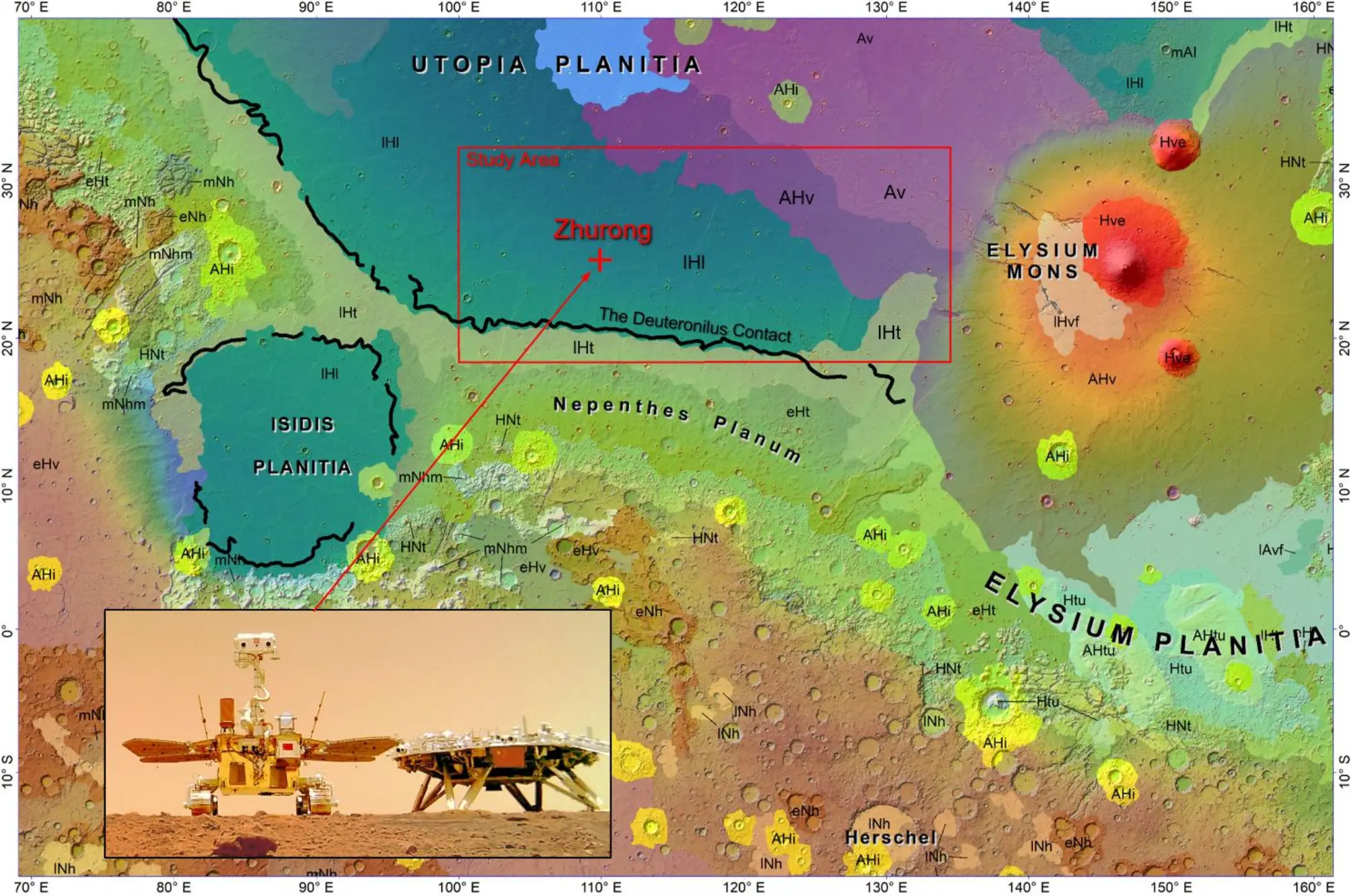
Zhurong landed in Utopia Planitia, a large region known as a broad plain in the northern hemisphere. “Flat” might sound boring, but it is actually useful, especially for a first landing attempt. A safer landing zone reduces risks from steep slopes, giant boulders, and extreme terrain.
Utopia Planitia is also scientifically interesting. It has been linked to hypotheses about past water and possible subsurface ice, and it has landforms that can tell stories about climate cycles. A rover can use radar and surface imaging to look for layered deposits, soil properties, and signs of materials shaped by ice or water in the past.
Landing site selection is always a trade. You want the most exciting science site, but you also want a place that is safe for entry and landing. Tianwen-1 picked a region that could do both reasonably well.
Entry, descent, and landing, the most dangerous minutes
Mars landing is famously called “seven minutes of terror” for a reason. The spacecraft must go from high speed entry to a gentle touchdown, and it must do it mostly on its own. With Mars, there is no joystick control, the signal delay is too long.
While exact sequences vary by mission design, Mars landing generally includes these phases:
- Atmospheric entry, using a heat shield to survive intense heating and slowing.
- Parachute deployment, to reduce speed further in the thin air.
- Separation events, heat shield release, backshell operations, preparing landing radar or sensors.
- Powered descent, engines fire to slow down for the final approach.
- Touchdown, landing legs absorb impact and stabilize the platform.
Every stage has failure modes. Parachutes can deploy incorrectly. Sensors can misread altitude. Thrusters can overcorrect. A slight timing issue can cascade into a crash. So when Tianwen-1 achieved a successful landing and deployed Zhurong, it was not luck. It was careful engineering, testing, and conservative decision making.
Zhurong on the surface, what it did and why it mattered
Once on the ground, the rover phase starts with basic survival. The rover must unfold, check power systems, establish communications, and verify that its environment is safe for movement. Mars can be dusty, cold at night, and harsh on electronics.
Zhurong carried a set of instruments designed to study both what is in front of it and what is beneath it. Ground penetrating radar is a big deal here, because it can reveal layered structures and subsurface features without drilling. The rover also provided images that help interpret the terrain, soil textures, and the shapes of small features like dunes and ridges.
Rover science often works like this, observe a feature, form a hypothesis, measure it with instruments, then compare to other features. Over time you build a story. Even small rocks can be valuable, because they record ancient processes.
Another important part is the technology side. Driving on Mars is different from Earth. Wheels slip in loose soil. Slopes can be deceptive. The rover needs autonomy to avoid hazards. Each successful drive day proves more about mobility, planning, and long term operations.
Main difficulties and problems Tianwen-1 had to overcome
Every Mars mission has a list of “things that could go wrong,” and Tianwen-1 had a lot of them because it was doing multiple mission types at once.
1) Rocket and launch reliability
When the payload is expensive and unique, you need the rocket performance to be precise. A deep space mission depends on hitting the right departure conditions. Any major underperformance can reduce mission margin, and any major failure ends the mission immediately. Heavy lift rockets are powerful but complex, so the program has to be confident in engines, staging, and guidance.
2) Deep space navigation and communication
Unlike low Earth orbit satellites, a Mars mission is far away and the signal is weaker. Ground stations must track it over months, and the spacecraft must keep pointing high gain antennas accurately to maintain the link. At the same time, it must manage power, thermal conditions, and software reliability.
3) Mars orbit insertion risk
The orbit insertion burn is a single major event, you do not get many second chances. Engine performance, pointing accuracy, and timing all matter. If something glitches in those minutes, the mission can be lost.
4) Landing complexity
Landing is where many Mars missions fail. The environment is unforgiving, and you can not “test” it live before doing it. You can simulate and practice, but the real event is one shot.
5) Surface environment and dust
Mars dust is famous. It can cover solar panels, reduce power, and mess with mechanical parts. Temperature swings can stress materials. Dust storms can reduce sunlight significantly. Rovers must be designed with these realities in mind, plus careful energy management planning.
Even if everything is engineered well, Mars still sometimes surprises you. It is a planet that doesn’t care if you brought a perfect checklist…
Results and achievements
Tianwen-1 is considered one of the most important milestones in China’s space exploration history. The mission achieved several major results.
- Successful Mars orbit insertion, proving interplanetary navigation and capture.
- Successful landing, a high difficulty feat for any nation.
- Successful rover deployment, Zhurong operated on the surface and returned images and science data.
- Planetary mapping and remote sensing from the orbiter, supporting broad Mars science and future planning.
- Communications relay operations, showing systems integration between orbiter and rover.
In “space history” terms, it made China one of the very small group of space powers that have successfully landed and operated a rover on Mars. That is a club with very few members.
Science wise, Tianwen-1 contributed new imagery, terrain observations, and subsurface data from its landing region, adding another important dataset to Mars research. Different missions often complement each other. One rover studies a crater, another studies a plain, and together they paint a fuller picture.

What did Tianwen-1 help scientists learn?
Even when public headlines focus on “the landing,” the deeper value is the science. Tianwen-1 was designed to study Mars in multiple ways, from orbit and from the surface.
1) Surface materials and local geology
Zhurong’s close up observations help interpret the region’s geology. Soil texture, small rock distributions, dune patterns, and layered materials can all hint at wind processes, past water activity, or freeze thaw cycles. Mars is a “wind shaped” planet today, and understanding how wind moves material helps scientists read ancient landforms too.
2) Subsurface structure
Ground penetrating radar can reveal buried layers and structures. This is especially interesting in regions where scientists suspect buried ice, ancient sediments, or layered deposits. Subsurface data is like having an X ray view of the landscape, not perfect, but extremely valuable.
3) Weather and environmental monitoring
Mars weather affects mission operations and also informs climate science. Dust, temperature swings, and local atmospheric behavior all connect to how Mars evolved over time.
4) Global context from the orbiter
The orbiter can map large scale features and compare them across different regions. This helps place the rover’s local findings into a bigger story. If Zhurong sees a certain type of dune, for example, the orbiter can help identify whether similar dunes exist elsewhere and what that implies.
It is worth saying clearly, Mars science is slow and careful. Data is analyzed for months or years. Findings are compared with other missions and models. So “results” are not always one big discovery headline. Often it is many small, strong pieces of evidence that eventually reshape what we think.
Benefits beyond science, why this mission helps future projects
Tianwen-1 was science, but it also built experience and infrastructure. That has real benefits for the future.
1) Experience with deep space mission operations
Operating a Mars mission trains teams in planning, fault handling, software updates, and long duration communications. That experience is reusable for asteroids, Jupiter missions, or even sample return.
2) Better landing and rover technology
Landing systems improve with each mission. Engineers learn how sensors behave, how dust impacts surfaces, how thermal models match reality, and how mobility systems wear over time. Even if a rover lasts a limited period, the lessons last for decades.
3) Building a stronger Mars “map” for later exploration
Orbit data contributes to better landing site selection in future missions. The more you map, the more you can pick safe and scientifically valuable targets later.
4) Inspiring education and engineering
Space missions often boost interest in engineering, physics, software, and robotics. That effect is real. Many aerospace engineers started as kids who watched a rocket launch video and got hooked.
Interesting facts about Tianwen-1
- One launch, three roles, orbiter, lander, and rover in a single mission architecture.
- Zhurong’s name relates to a figure in Chinese mythology connected with fire, a fitting theme for a planet often called the “Red Planet.”
- Landing site choice balanced safety and science, a flat plain can still hold major clues beneath the surface.
- Mars windows matter, missions usually launch when Earth and Mars align well, roughly every 26 months.
- Orbit plus surface data is powerful, it lets scientists connect local ground truth to global patterns.
How Tianwen-1 fits into the bigger “rocket story”
Space exploration is basically a chain of bigger and better rockets plus smarter spacecraft. Tianwen-1 is part of that chain. Heavy rockets enable heavier payloads, which enable more instruments, better communication, safer landing systems, and longer missions.
If you like comparing major launch systems and what they changed in space history, you might also enjoy reading about some other famous heavy lift moments. Falcon Heavy’s first launch showed how a private company could field a heavy rocket and reuse boosters, Energia shows how ambitious Soviet heavy lift once was, and Starship is aiming for an even bigger step in payload and reusability. These comparisons help you understand why Long March 5 is important too…
Final thoughts
Tianwen-1 (yes, often mistyped as Tianwan 1) is a mission that deserves a detailed look because it was not “just a Mars flyby.” It combined complex steps and made them work. Launch, cruise, orbit insertion, landing, rover operations, and ongoing orbital science, each one is hard on its own, together they are even harder.
The mission also showed something bigger, space exploration is not only about one nation. Each successful Mars mission adds data, engineering lessons, and new perspectives. Mars is a giant puzzle, and every orbiter and rover adds a few more pieces to it. That means readers, students, and future engineers benefit too, because knowledge grows with every mission… even when the headlines move on quickly.
Common Questions
The official name is Tianwen-1. “Tianwan 1” is a common typo people use online, but it refers to the same mission in most cases.
It aimed to orbit Mars, study the planet from above, and also land and operate the Zhurong rover on the surface to collect local science data.
Mars has a thin atmosphere, so you get dangerous heating during entry, but not enough air for parachutes alone to slow you fully. Missions must combine heat shields, parachutes, sensors, and powered descent with high autonomy.
Zhurong studied terrain, soil, and local geology, and it supported subsurface investigation using radar style measurements, plus imaging and environmental monitoring.
No. The orbiter is a major science platform too. It provides broader mapping and remote sensing, and it can support communications relay for surface missions.
Reference
- Tianwen-1 : WikiPedia
- Tianwen-1: China’s first Mars mission : Space
- Tianwen-1 and Zhurong, China’s Mars orbiter and rover : The Planetary Society
- TianWen-1