Venera Mission, The Soviet Triumph That Conquered Venus
Introduction
When you think of space exploration, names like NASA and Apollo often steal the spotlight. But hidden behind the curtain of the Cold War space race, the Soviet Union achieved something that many people today have almost forgotten. They conquered Venus. Not just a flyby, not just a crash, but a series of successful, soft landings on the most hellish planet in our solar system…
We often hear about missions to Mars, but getting a spacecraft to survive on Venus is a whole different level of engineering nightmare. The planet has a surface temperature hot enough to melt lead, and atmospheric pressure that would crush a submarine like a soda can. Yet, between 1970 and 1985, the Venera program not only landed on Venus but sent back the first pictures from another planet’s surface. This article will take you through the incredible journey of the Venera missions that successfully soft landed on Venus, the technology that made it possible, and the surprising discoveries they made.
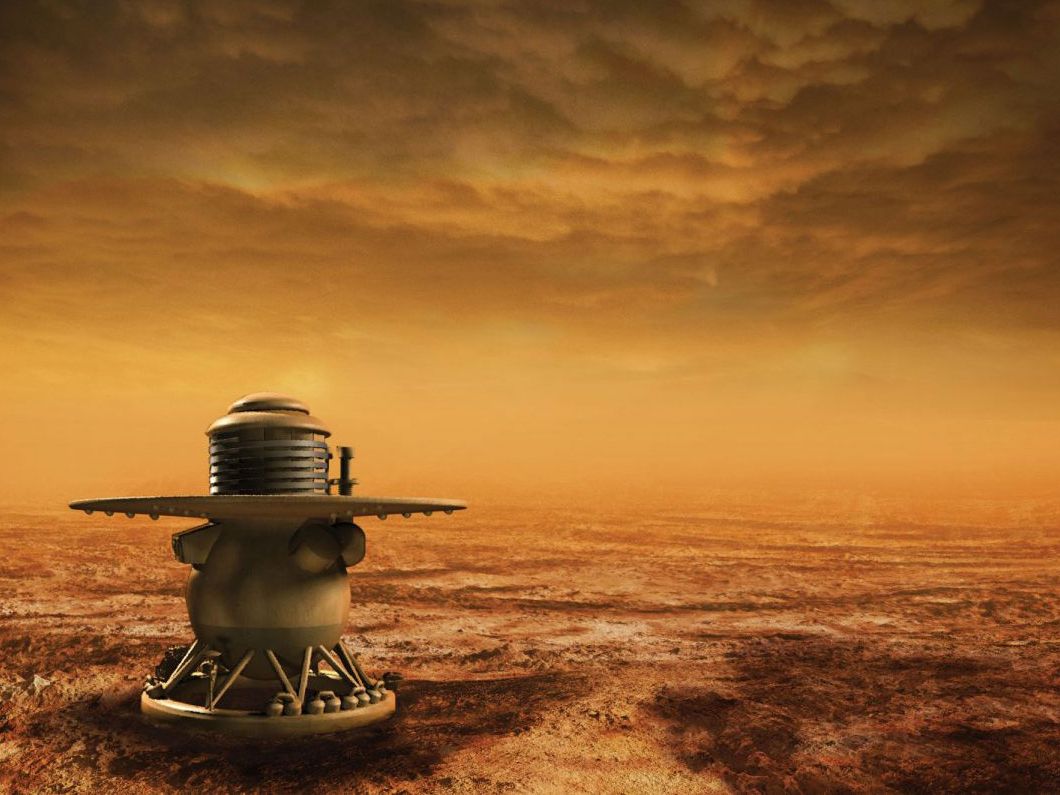 Credit: Soviet Space Program
Why Venus is a Engineering Hellscape
Before we dive into the missions themselves, we need to understand why landing on Venus is so insanely difficult. This context makes the Venera achievements even more remarkable.
Venus is often called Earth’s “evil twin”. It is similar in size and composition, but the similarities end there. The planet is covered in thick clouds of sulfuric acid. The atmosphere is 96% carbon dioxide, creating a runaway greenhouse effect. The surface pressure is a crushing 92 bar (over 1300 psi), which is equivalent to being 900 meters deep in Earth’s oceans. The average surface temperature is a staggering 475 degrees Celsius (900 degrees Fahrenheit), which is hotter than the surface of Mercury despite Venus being farther from the Sun.
On top of the heat and pressure, the probes had to survive the descent. Entering the atmosphere at 11 kilometers per second, the spacecraft experienced brutal deceleration forces, sometimes exceeding 150 Gs. To make matters worse, the thick clouds mean no sunlight reaches the surface directly, just a dim, orange glow. Any probe sent there had to be massively overbuilt, heavily insulated, and equipped with specialized cooling systems. Most early attempts failed, but the Soviets persisted…
The person behind much of this early planetary ambition was Sergei Korolev, the chief designer of Soviet space technology. Although he passed away in 1966, his vision for Venus exploration lived on through his collegues.
The First Soft Landing, Venera 7 (1970)
After several failed attempts and atmospheric probes that were crushed before reaching the ground, the Soviets designed Venera 7 specifically to survive. The earlier Venera 4, 5, and 6 had successfully transmitted atmospheric data but were destroyed by the pressure before touchdown. Venera 7 was different. It was “massively overbuilt” to ensure survival, using a titanium pressure vessel with no seams or welds. The engineers at Lavochkin Design Bureau worked tirelessly to create a sphere that could withstand 180 atmospheres, double the expected pressure.
Launched on August 17, 1970, Venera 7 traveled for four months. On December 15, 1970, it entered the Venusian atmosphere. The descent was terrifying. The main parachute, designed to slow the probe, ripped and partially collapsed. The lander fell freely for 29 minutes, impacting the surface at about 17 meters per second (38 mph). For a moment, the signal went dead. Engineers thought it had been destroyed.
But then, a weak signal appeared. The probe had survived the impact but was lying on its side, its antenna pointing away from Earth. For 23 minutes, it transmitted a faint whisper of data. Analysis of the signal by Vladimir Perminov and his team revealed the first direct measurements from the surface of another planet: a temperature of 475°C and a pressure of 92 bar. Venera 7 had made history. It became the first spacecraft to successfully perform a soft landing on another planet and the first to transmit data from there back to Earth.
Confirming the Data, Venera 8 (1972)
Venera 8 launched on March 27, 1972, and arrived at Venus on July 22 of that year. This mission was designed to build on the success of Venera 7 and conduct more sophisticated measurements. It landed on the sunlit side of the planet, which was a risk because the temperatures were even higher there.
The descent was smoother this time. Venera 8 measured the light level on the surface using a photometer, finding it to be similar to Earth on an overcast day, with roughly 1 km visibility. This was crucial information because it proved that surface photography was possible. The probe also confirmed the extreme temperature and pressure readings from its predecessor (470°C, 90 atmospheres). Furthermore, it carried a gamma-ray spectrometer that measured the concentration of radioactive elements in the soil, hinting at a rock composition similar to granite or other igneous rocks on Earth. Venera 8 operated for 63 minutes on the surface, a significant achievement.
One interesting detail: the landing site of Venera 8 was illuminated by sunlight that had filtered through the thick clouds, and the probe’s sensors detected a strange ultraviolet absorption phenomenon, later linked to sulfur dioxide in the upper clouds.
The First Images, Venera 9 and 10 (1975)
This is where the Venera program truly captured the world’s imagination. Venera 9 and Venera 10 were twin missions, launched just days apart in June 1975. They consisted of orbiters and landers. The orbiters would relay data from the landers and map the planet from above.
On October 22, 1975, the Venera 9 lander touched down on a steep slope. For 53 minutes, it transmitted data, but its most important payload was the camera. It snapped the first-ever photograph of the surface of another planet. The image showed a rocky, rugged landscape with angular rocks, some partially buried in soil. The horizon was visible in the corners. The camera system was designed by Alexander Selivanov, and it used a scanning mechanism rather than a standard lens, which was more resistant to the harsh conditions.
Three days later, Venera 10 landed about 2,200 km away. It operated for 65 minutes and returned its own images, showing flat slabs of rock, similar to a volcanic area on Earth. Unfortunately, on both landers, one of the two camera lens covers failed to eject, limiting the panoramas to 180 degrees instead of 360. Despite this, the images were revolutionary. They showed a barren, dry, volcanic landscape under a thick, orange sky. The surface was surprisingly dark, reflecting only about 5% of the light that hit it, similar to fresh asphalt.
Listening for Thunder, Venera 11 and 12 (1978)
Venera 11 and Venera 12 launched in September 1978. These missions focused more on atmospheric chemistry and electrical activity than photography. The landers carried a device named “Groza” (meaning “Thunderstorm”) to measure electrical discharges.
Both landers made successful soft landings in December 1978. However, both also experienced camera failures. The lens covers on Venera 11 failed to eject, so no images were returned. The soil sample on Venera 11 was also not placed correctly into the analysis chamber. It was a bit of a disappointment on the imaging front.
But the scientific return was still massive. The Groza experiment detected a large number of electromagnetic pulses during descent, providing strong evidence of lightning on Venus. The probes also discovered carbon monoxide at low altitudes and found sulfur and chlorine in the cloud layers. The data suggested that Venusian lightning is similar in energy to Earth lightning, but with a higher pulse repetition rate. Additionally, the landers measured the speed of sound in the Venusian atmosphere, which turned out to be around 240 meters per second, slightly slower than on Earth due to the dense CO2.
The Golden Age, Venera 13 and 14 (1982)
The most successful and famous of the Venera landers were Venera 13 and Venera 14. Launched in October and November 1981, they arrived in March 1982. These were the most advanced landers of the program.
Venera 13 touched down on March 1, 1982. It survived the hellish environment for an astonishing 2 hours and 7 minutes, long enough to obtain 14 color images. It produced the first color panorama of the Venusian surface. The true color is difficult to judge because the atmosphere filters out blue light, giving everything a yellowish-orange hue. The images showed flat rock slabs, soil, and part of the spacecraft itself, including a camera lens cover lying on the ground. The surface composition was found to be similar to terrestrial basalt, a common volcanic rock. The probe also carried a drill and soil sampling mechanism, which successfully retrieved a sample and placed it into a sealed chamber for X-ray fluorescence analysis.
Venera 14 landed two days later, about 1,000 km away. It transmitted for 57 minutes and also returned color photographs. It performed a soil analysis using an X-ray fluorescence spectrometer, confirming the basaltic composition. Interestingly, the drill on Venera 14 accidentally encountered a hard rock or a piece of the spacecraft’s own ejecta cover, preventing a proper sample. The temperature at its site was even slightly higher: 470°C and 93.5 atmospheres of pressure. These missions provided the most detailed understanding of the Venusian surface until the Magellan mission arrived years later.
The Final Act, Vega 1 and 2 (1985)
The Venera program officially evolved into the Vega program (a contraction of “Venera” and “Gallei”, the Russian word for Halley). These were dual-purpose missions designed to explore Venus on the way to Halley’s Comet.
Launched in December 1984, the Vega 1 and Vega 2 spacecraft reached Venus in June 1985. Each deployed a Venera-style lander and, for the first time, a sophisticated balloon probe. The balloons were deployed in the Venusian atmosphere at an altitude of about 54 km, where the pressure and temperature are much more Earth-like. They drifted with the winds for about 46 hours, traveling nearly one-third of the way around the planet. Sensors on the balloons measured pressure, temperature, vertical wind velocity, and cloud density. It was a brilliant engineering feat and provided unique data on the dynamics of the Venusian atmosphere.
The landers themselves touched down successfully but had short operational lives. Vega 1’s soil sampler unfortunately malfunctioned, but Vega 2 returned data. After their Venus flybys, both spacecraft continued to Halley’s Comet, conducting successful flybys in March 1986. The Vega mission remains the only example of a single spacecraft successfully studying two completely different celestial bodies (Venus and a comet) during one journey.
Key Scientific Discoveries and Benefits
The Venera missions fundamentally changed our understanding of Venus. Before these landings, scientists speculated about a swampy or oceanic world based on the thick clouds. The Venera probes revealed the truth.
Here are the key takeaways from the missions:
- The Atmosphere is Crushing: Confirmed surface pressure of 90-95 bar, equivalent to being nearly a kilometer under the sea.
- The Heat is Unimaginable: Temperatures consistently measured around 475°C, hot enough to melt tin and lead. No other planet’s surface is hotter, not even Mercury.
- The Surface is Volcanic: The images and soil analysis from Venera 13 and 14 showed a landscape dominated by basaltic rock, similar to the dark volcanic plains on Earth or the Moon. Later orbiter data suggested widespread volcanic activity.
- Lightning Exists: Venera 11 and 12 confirmed the presence of electrical discharges (lightning) in the thick cloud layers, a phenomenon still not fully understood on Venus.
- Scattered Light: Venera 8 and later missions measured the light levels, proving that photography was possible despite the thick clouds. The visibility is about 1 km, similar to a very foggy day on Earth.
- Wind Speeds: During descent, the probes measured wind speeds increasing dramatically near the surface, from a gentle breeze at high altitudes to a slow creep of about 0.5 to 1 meter per second at the ground.
Beyond the scientific data, the Venera program provided immense engineering benefits. The lessons learned in building spacecraft to survive extreme temperatures and pressures have informed the design of probes for other hostile environments, including entry probes for gas giants like Jupiter and Saturn. The Pioneer Venus Multiprobe and Galileo probe owe a debt to Venera’s rugged design philosophy.
Challenges and Legacy
The Venera program was not without its failures. The Soviets kept many of their failed missions secret, designating them as “Kosmos” launches. The early Venera 1 and 2 lost contact before reaching Venus. Venera 3 crash-landed. Venera 4, 5, and 6 were crushed before reaching the surface. Even the successful landers had issues, like stuck camera lens covers and malfunctioning soil samplers.
But the sheer number of successes is staggering. Out of roughly 30 attempts, 10 probes successfully landed on the surface and transmitted data. No other space agency has achieved a soft landing on Venus since. The Venera program remains the most extensive and sustained effort to explore another planet’s surface to date. The United States had the Mariner and Pioneer Venus orbiters, but never a successful lander (the Pioneer Venus Multiprobe had probes that survived for a short time but they were not designed for soft landing).
The legacy is clear. The Venera missions gave us our only close-up look at the surface of Venus for decades. Until NASA’s Magellan mapped the planet with radar in the 1990s, everything we knew about the Venusian landscape came from those grainy, black-and-white, and eventually color, panoramas sent back by the Soviet probes. They are a testament to human ingenuity and the relentless desire to explore, even when the target is actively trying to destroy your spacecraft…
Final Thoughts
The Venera missions are a fascinating, often overlooked chapter in space history. While the world watched the Moon landings, the Soviets were quietly, and successfully, conquering the most difficult planet in the solar system. They turned a theoretical hellscape into a real, measured, and photographed world.
These missions remind us that exploration is not always about the flashy headlines. Sometimes, it is about building a titanium sphere strong enough to withstand the pressure of an ocean, packing it with delicate electronics, and hurling it into a furnace to see what happens. The Venera program was bold, relentless, and scientifically magnificent. The next time you look up at the evening star, remember that we have footprints on the Moon, but we have pictures from Venus… and those pictures came from the incredible, underappreciated Venera missions.
Common Questions
A total of ten probes from the Venera series successfully landed on the surface of Venus and transmitted data back to Earth. This includes the Vega landers from 1985.
Venera 7 was the first spacecraft to perform a successful soft landing on another planet (Venus) and transmit data back to Earth on December 15, 1970.
Survival times varied due to the extreme heat and pressure. Venera 7 lasted 23 minutes, Venera 8 lasted 63 minutes, Venera 9 lasted 53 minutes, Venera 10 lasted 65 minutes, and Venera 13 lasted an impressive 2 hours and 7 minutes.
Yes. Venera 9 took the first black and white images of the surface of another planet in 1975. Venera 13 and 14 returned the first color images in 1982.
The Venera landers, particularly Venera 13 and 14, analyzed the soil composition and found it to be similar to terrestrial basalt, a common volcanic rock found on Earth.
The Vega program was a continuation of the Venera missions. It involved two spacecraft that deployed landers and atmospheric balloons on Venus before continuing on to fly by Halley’s Comet in 1986.
NASA focused more on Mars and outer planets due to different strategic priorities. The extreme conditions on Venus made landings very expensive and difficult. The Soviets specialized in Venus because their heavy launch vehicles allowed them to send robust probes.
Reference
- Venus Exploration : By NASA
- Venera Program : By Wikipedia
- Venera Soviet Space Probes : By Britannica