Vostok 1, The First Human Flight to Space That Changed History
Introduction
Some moments in history feel like a door opening. Before that moment, the idea sounds impossible, after it happens, the world has to accept a new reality. Vostok 1 was one of those moments…
On April 12, 1961, Soviet cosmonaut Yuri Gagarin became the first human to travel into space and orbit Earth. The mission lasted just under two hours, it completed a single orbit, and yet the impact was massive. It reshaped politics, science, engineering, education, and even culture. People who had never cared about rockets suddenly looked up, because for the first time, a human had actually left the planet and came back alive.
- Mission: Vostok 1
- Date: April 12, 1961
- Crew: Yuri Gagarin (solo)
- Type: Orbital spaceflight, 1 orbit
- Total time: about 108 minutes (launch to landing)
This article will explain why Vostok 1 happened, how it worked, what risks it faced, and what it changed. If you already read about earlier steps like Sputnik 1, you will see how that first “beep” eventually led to the first human orbit.
The world before Vostok 1, why it was even possible
Vostok 1 did not appear out of nowhere. It was the result of a fast moving chain of events in the late 1950s and early 1960s, when the United States and the Soviet Union were racing to prove technological strength. Space became the most dramatic scoreboard because it combined rockets, guidance systems, engineering discipline, and national pride all in one.
Sputnik 1 in 1957 showed that a rocket could put a payload into orbit. That alone was a huge shock worldwide. If you can place an object in orbit, it means you can launch something at very high speed and control the flight. After Sputnik, the question quickly became, “Can we send a person?”
Putting a person into space is not just adding weight. It adds life support, pressure control, temperature stability, reentry safety, and the biggest unknown at the time, how the human body and mind react to weightlessness and the stresses of launch and landing. Engineers had to build a system where one failure would not instantly become fatal… and that is hard.
Why the Soviets wanted the first human spaceflight so badly
There were scientific reasons, but also political reasons. On the science side, a human in orbit could provide real data about life support systems, human health, and spacecraft operations. On the political side, being first would send a strong message: “We can do things that nobody else can.”
In that era, rocket technology was strongly linked to military capability, even if the space program itself had many peaceful goals. So success in space could indirectly shape global perception of power.
But it wasn’t only about governments. Spaceflight also inspired young people to study engineering and physics. It pushed new industries, better materials, better radios, better automation. Even people who never became scientists felt something shift in their imagination. Space was no longer just science fiction…
Who was Yuri Gagarin, and why he was chosen
Yuri Gagarin was a Soviet Air Force pilot who became one of the early cosmonaut candidates. The selection process involved physical health, psychological stability, and the ability to stay calm under pressure. It also involved practical factors like height and weight, because the Vostok capsule was cramped and had strict limits.
Gagarin was known for being disciplined, friendly, and steady. Many accounts describe him as someone who could keep a clear head even in tense situations. That matters because Vostok 1 was not a normal “pilot the craft” mission. Much of it was automated, but the human inside still had to handle stress, communication, and emergency readiness.
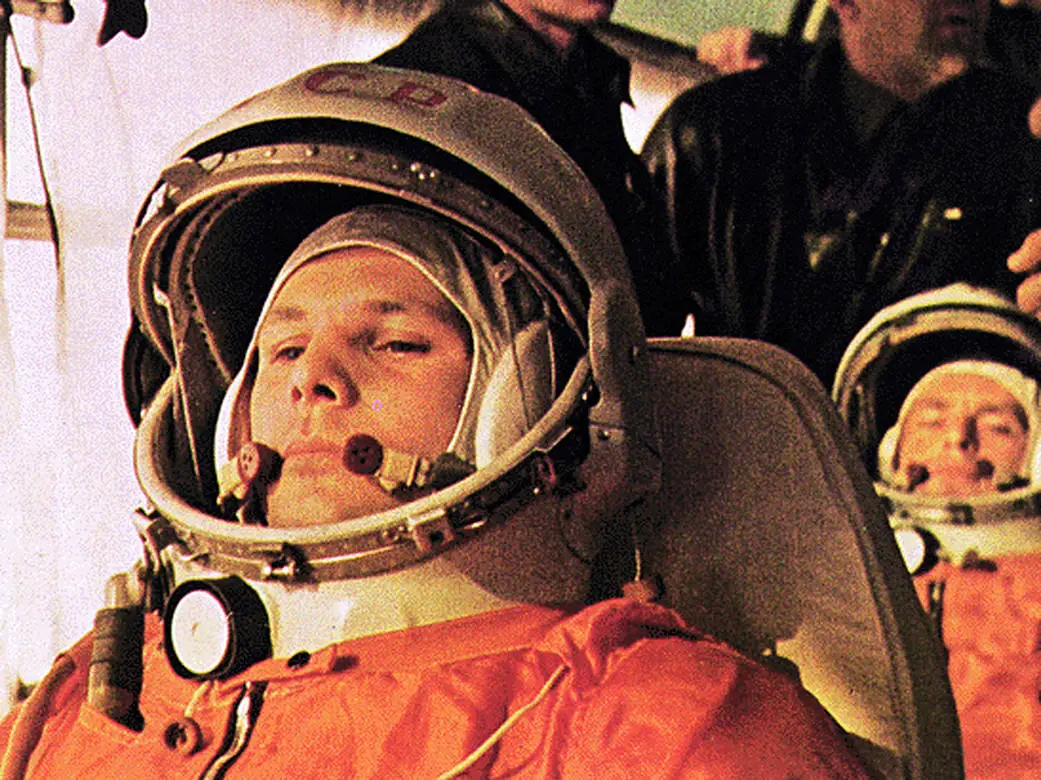
One important point, the first human spaceflight was not just a test of bravery, it was a test of systems. The cosmonaut had to trust the rocket, the capsule, the life support, the heat shield, the parachute, the communications chain, and the recovery team. Gagarin’s calm reputation made him an ideal face for such a risky leap.
The Vostok spacecraft, simple looking, complex job
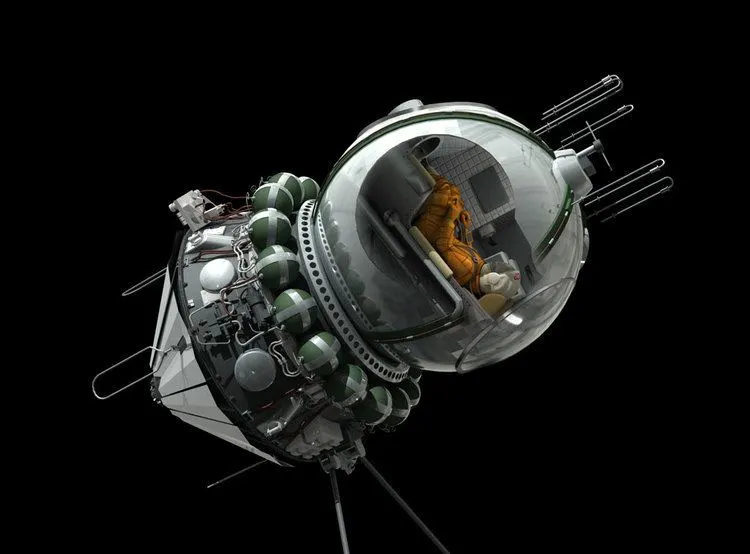
When you see the Vostok capsule, it can look surprisingly plain compared to modern spacecraft. But its design choices were very intentional. Vostok was built to get one person into orbit and back safely, not to do fancy maneuvers or long missions.
Two main sections
- Descent module: a spherical reentry capsule designed to survive the intense heat of returning through the atmosphere.
- Service module: carried equipment like batteries, oxygen systems, orientation controls, and engines needed for orbital operations and deorbit burn.
The sphere shape mattered because it handled reentry heating more evenly. Some later spacecraft used different shapes for better lift and control, but the sphere was a reliable early choice. It is not the most comfortable shape for a human inside, though, so the interior was tightly packed.
Life support, oxygen, pressure, temperature
Vostok 1 had to keep Gagarin alive in a sealed environment. That means oxygen supply, removal of carbon dioxide, humidity control, and temperature management. In space you cannot open a window if it gets too hot. Everything has to be calculated and tested.
Manual control was limited on purpose
One of the most interesting details is that the mission was designed to run mostly on autopilot. At the time, there was real concern about how weightlessness might affect a human’s ability to think and react. Would someone panic? Would they faint? Would they make dangerous mistakes? Engineers didn’t know for sure, so they leaned heavily on automation.
Manual control existed for emergencies, but it was locked behind a code system, intended to prevent accidental or irrational actions. That detail alone shows how unknown space still was in 1961…
The rocket, Vostok-K and the climb into orbit
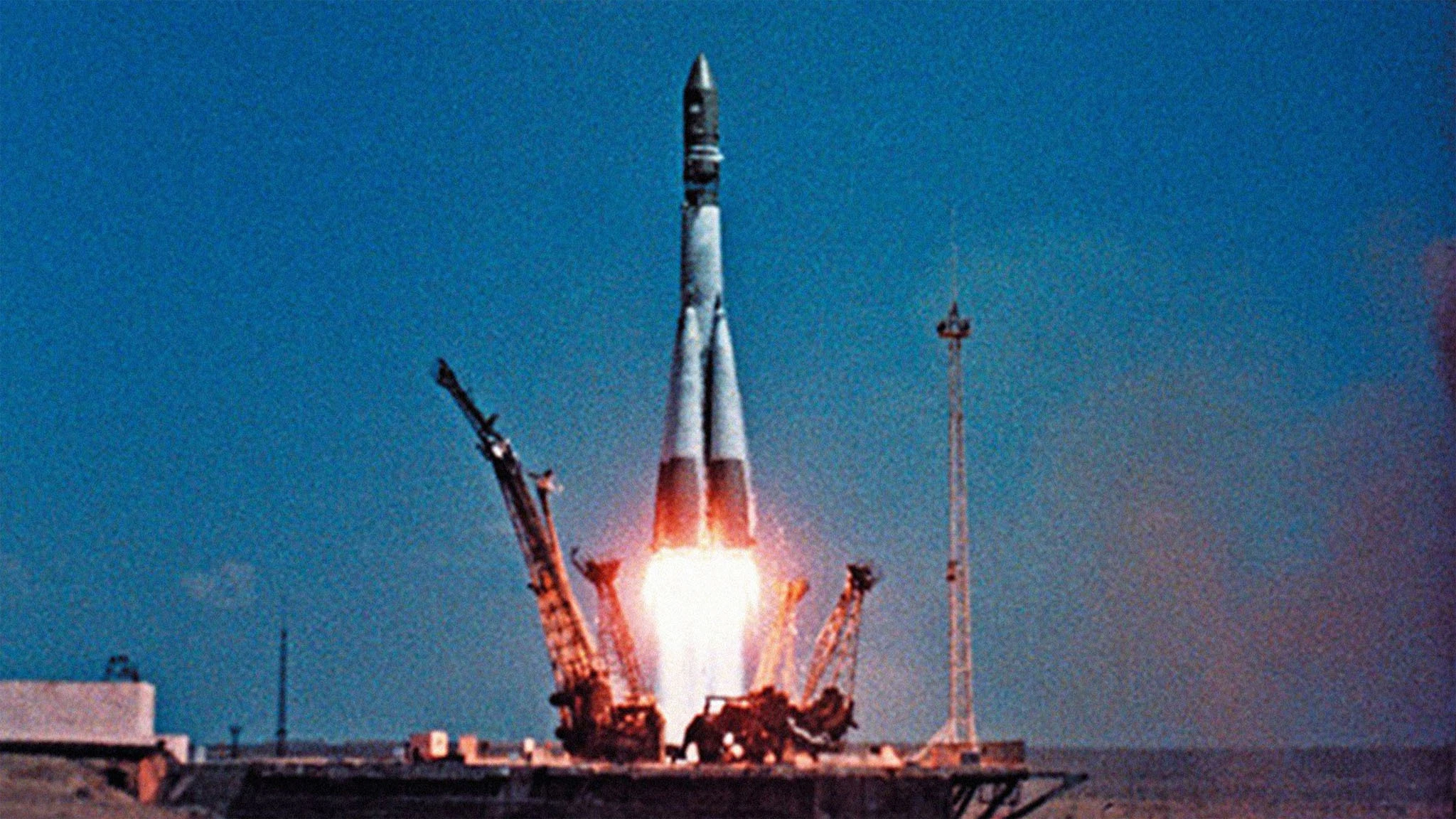
To orbit Earth, you need enormous speed, roughly 7.8 km/s for low Earth orbit, plus extra for losses during ascent. That requires a powerful multi stage rocket. Vostok 1 used a rocket from the R-7 family, evolved from earlier Soviet designs that had already proven they could reach orbit with satellites.
Launch was from Baikonur Cosmodrome, which is in modern day Kazakhstan. From there, the rocket had to lift the spacecraft through thick atmosphere, then accelerate it to orbital speed before releasing it into free fall around Earth.
During ascent, the human experiences vibration, loud noise, and strong acceleration forces. Spaceflight movies sometimes make it look smooth. In real life, early rockets especially could be rough, even if they were successful.
How Vostok 1 worked, the mission step by step
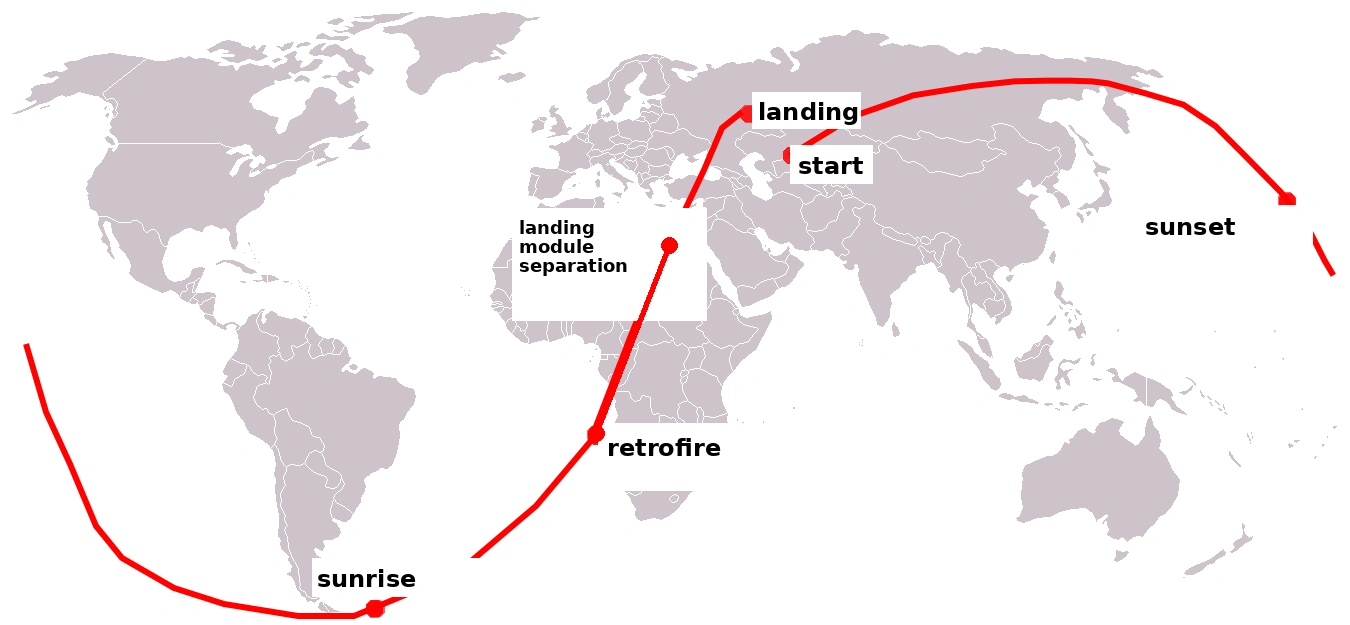
It helps to think of Vostok 1 as a carefully timed chain. If one link breaks at the wrong moment, you might not get a second chance. Here is the mission story in a clear timeline style…
| Phase | What happened | Why it mattered |
|---|---|---|
| Launch | Rocket lifts off from Baikonur, Gagarin begins the ride upward, the famous “Poyekhali!” is linked to this moment. | Launch is one of the riskiest moments, engines and staging must work correctly. |
| Ascent and staging | Multiple stages separate as fuel is used, the rocket keeps accelerating to orbital speed. | Staging failures were a major danger in early rocketry, correct timing is critical. |
| Orbit insertion | Vostok 1 reaches orbit, the spacecraft is now falling around Earth instead of falling back down. | Being in orbit is what made it the first true human orbital mission. |
| In orbit | Gagarin experiences weightlessness, communicates with ground, the spacecraft systems monitor health and performance. | This was the first real human data on orbital flight, not just short suborbital hops. |
| Deorbit burn | The spacecraft fires a retro rocket to slow down, shifting the orbit so it intersects Earth’s atmosphere. | If the burn fails, the capsule could stay in orbit longer than planned, with limited supplies. |
| Reentry and separation | Service module separates, the descent module reenters and heats intensely, then slows and descends. | Separation and heat shield performance were life or death issues. |
| Landing | Vostok used a parachute system, and Gagarin ejected and landed separately by parachute in the final phase. | This was part of the design, it reduced risk from hard capsule impact. |
During the orbit, Gagarin reportedly ate and drank, monitored sensations, and stayed in contact. A lot of it was routine, which might sound boring, but “boring” is good in space. Boring means systems are working…
Difficulties and dangers, what could have gone wrong
Modern spaceflight is still risky, but the early era was especially uncertain. With Vostok 1, the engineers had to predict things that nobody had directly experienced. Here are some of the biggest challenges and risks, explained simply.
1) Human response to weightlessness
Today we know humans can live and work in microgravity for long periods, with challenges like bone density and muscle loss. In 1961, they did not have that confidence. Short animal flights helped, but a human is not a dog or a monkey. The mission needed to prove that a person could stay conscious, communicate, and remain emotionally stable in orbit.
2) Guidance and orientation in orbit
A spacecraft must know which way it is pointing. Orientation affects communications, power systems, and the direction of the deorbit burn. If the craft tumbles or points wrong, the retrofire could send it into a dangerous path. Vostok used automated orientation systems that had to work without a pilot flying it like a plane.
3) Deorbit timing, too little or too much
The deorbit burn is like tapping the brakes while moving extremely fast. If the burn is too small, the spacecraft stays in orbit longer than planned. If it is too strong, the reentry angle can become too steep, leading to extreme heating and forces. The margin for error is not huge…
4) Separation issues
After the deorbit burn, the service module should separate cleanly from the descent module. If they don’t separate properly, the combined shape can tumble, causing unstable reentry heating. Early missions in general had to deal with separation being more difficult than it sounds on paper.
5) Landing method, ejection and parachute
Vostok’s design involved the cosmonaut ejecting and landing by parachute near the end. That adds extra steps, and extra steps always add risk. But it also avoided the descent module slamming into the ground too hard. It was a tradeoff, a classic space engineering decision.
Some early public reporting avoided talking about the ejection landing method. There were record certification rules in aviation sports circles that expected pilots to land with their craft. Over time, the full details became widely known and accepted as part of the Vostok system.
Where did Vostok 1 land?
Vostok 1 did not land on a runway. It came down by parachute and landed in the Soviet Union, in the broader Saratov region area, near the city of Engels in many accounts. Local people reportedly saw the parachutes and were shocked to meet a space traveler. Imagine you are in a field and suddenly a person in an orange suit drops from the sky, it sounds unreal…
Recovery teams had to locate the landing area, secure the cosmonaut, and transport him safely. Landing and recovery might sound like “after the mission,” but in reality it is still part of the mission’s success.
Results, what Vostok 1 proved to the world
Vostok 1 proved several things at once, which is why it hit so hard globally.
- A human can survive launch, orbit, and reentry. That was not guaranteed before 1961.
- Life support can work in space. Pressure, oxygen, temperature, and CO2 control could be managed.
- Automation can handle orbital flight. This influenced later spacecraft design philosophies.
- Reentry and parachute recovery can return a living person. It made future missions feel achievable, not just theoretical.
It also created an emotional impact. The first time someone looked down on Earth from space and returned to talk about it, it changed how many people thought about our planet. Even short missions can change perspective…
The impact on the Space Race, and what came next
After Vostok 1, the pressure increased for the United States to respond. Spaceflight became headline news, and funding decisions were influenced by these milestones. Soon after, the US flew its own early crewed missions, first suborbital, then orbital. The Space Race accelerated rapidly.
But Vostok 1 did more than push competition. It also pushed technology forward. Once humans were in orbit, the next questions were, can they stay longer, can two spacecraft meet, can we dock, can we walk in space, can we go to the Moon?
If you want to see how the US side evolved into longer missions and complex operations, you can connect this story with Project Gemini. Gemini was all about learning to rendezvous and dock, skills that later made Apollo possible.
And if you want the “big finish” of that era, your Apollo coverage fits naturally here, because Vostok 1 is one of the stepping stones that helped set the pace for the Moon landing later. See Apollo 11 for the most famous milestone that followed in the same decade.
Benefits of Vostok 1, beyond the headline
It is easy to think Vostok 1 was “just a stunt,” but that misses the deeper benefits. Even one orbit created valuable knowledge and momentum.
1) Human factors and space medicine
Vostok 1 gave real data about how a person feels in microgravity, how breathing and circulation behave, and whether communication stays clear. That knowledge fed into longer duration planning.
2) Engineering confidence and design lessons
It proved that heat shields, parachutes, and sealed cabin systems could work as a complete chain. A spacecraft is not a single invention, it is many systems stacked on top of each other. Vostok 1 validated the stack.
3) Faster progress for satellites and science missions
When governments and industries invest in space tech, the benefits do not stay only in crewed missions. Improved rockets and guidance can also launch better weather satellites, communications satellites, and research probes.
For example, if you jump decades forward, you get robotic explorers like Voyager 1 traveling far beyond the planets, and modern planetary missions like Tianwen-1. Human milestones helped keep the space “engine” running, which also supports robotic science.
4) Culture, education, and motivation
A lot of engineers, programmers, and scientists later said they were inspired as kids by early human spaceflight. That is a real benefit, inspiration builds careers, careers build inventions, inventions build future possibilities…
Common myths and misunderstandings
Because Vostok 1 is so famous, myths often follow it around. Here are a few cleared up in a simple way.
- “Vostok 1 was just a short hop”, no, it was an orbital flight. Orbit is a different class than suborbital.
- “Gagarin piloted it like a plane”, not really. The mission was heavily automated, with limited manual control in emergencies.
- “He landed inside the capsule”, the Vostok landing system involved ejection and separate parachute landing for the cosmonaut.
- “Space was already ‘solved’ after this”, not even close. It was the beginning, many major risks remained for longer missions.
Interesting facts about Vostok 1
- April 12 is celebrated in many places as a special day linked to human spaceflight history.
- Gagarin’s calm communication style helped reassure mission control and the public.
- The capsule was designed for strength and reliability, comfort was not the priority.
- Vostok missions after Vostok 1 expanded duration and tested more human factors.
- Even today, the idea of “first human in space” remains one of the most recognized scientific milestones worldwide.
How Vostok 1 connects to later big space hardware
Vostok 1 was early and relatively simple, but it sits on the same timeline that later produced giant rockets and stations. The Soviet program evolved through many designs and eventually supported ambitious heavy lift concepts.
If you want a deeper look at later Soviet era rocketry direction and how that world evolved, your Energia article makes a good bridge, Unveiling Soviet Energia Rocket. Energia came much later, but understanding Vostok helps you see how experience and ambition can grow across decades.
And on the US side, the journey from early human flights eventually contributed to station living, like Skylab. It is a nice reminder, first you prove you can survive one orbit, then you learn to live up there for weeks and months…
Final thoughts
Vostok 1 is sometimes described in one sentence, “first human in space.” But the real story is bigger. It is about how quickly humans turned a new idea into reality, and how many systems had to cooperate perfectly for just one orbit to happen.
It is also a reminder that big achievements often start with a mission that looks small on paper. One orbit, less than two hours, only one person. Yet that single flight changed what humanity believed was possible… and it pushed the world into an era where space became a real place we could reach.
If you want to build a strong reading path on your site, it can go like this: start with the shock of Sputnik 1, then Vostok 1 as the first human orbit, then Project Gemini for learning space operations, then Apollo 11 for the Moon, and after that robotic legends like Voyager 1…
Common Questions
Vostok 1 was an orbital spaceflight. It completed one full orbit around Earth before beginning reentry..
The full mission from launch to landing is commonly given as about 108 minutes. Time “in orbit” is a bit less than that, because launch and landing are included in the total.
Most of Vostok 1 was automated. Manual control options existed mainly for emergencies, but the mission plan relied on autopilot because spaceflight effects on humans were still uncertain at the time.
Vostok used a system where the cosmonaut ejected and landed by parachute near the end of descent. This reduced the risk of hard capsule impact on the ground.
Because it proved a human could survive orbital flight and return safely, and that single proof accelerated technology, funding, and global interest in space exploration..
A good next path is Project Gemini for space operations, then Apollo 11 for the Moon, and later missions like Skylab for long duration living in orbit.
Reference
- Vostok 1 : Wikipedia
- Yuri Gagarin on Vostok 1, How the 1st Human Spaceflight Worked : Space.com
- The flight of Vostok 1 : European Space Agency
- Vostok spacecraft overview : Britannica
- Yuri Gagarin and Vostok 1 : The Planetary Society