Exoplanets: The Worlds Beyond Our Sun That Are Rewriting Everything We Thought We Knew
Stand outside tonight, look up at any random star, and try to wrap your head around this… that little dot of light might have an entire family of planets circling it right now. Some could be baked to a crisp, others frozen solid, a few might have oceans lapping against alien shores while clouds drift across two suns in the sky. Thirty years ago that was pure Star Trek fantasy. Today, in December 2025, we have confirmed more than 5,800 exoplanets and the number climbs literally every week. This isn’t just a bunch of data points anymore, this is the greatest detective story humanity has ever tackled… and we’re only in chapter three.

The crazy 1990s: from zero to “wait, what is that thing?”
Rewind to 1992. Two radio astronomers, Aleksander Wolszczan and Dale Frail, were listening to a pulsar called PSR B1257+12, basically a dead neutron star spinning 160 times a second and blasting radiation like a lighthouse from hell. They noticed tiny timing glitches in its pulses… glitches that could only be explained by planets tugging on it. Two, maybe three rocky worlds orbiting a corpse star. The first exoplanets ever confirmed. Nobody celebrated much because, honestly, who wants to live there?
The real earthquake hit on October 6, 1995. Michel Mayor and Didier Queloz at the Geneva Observatory were watching a perfectly normal Sun-like star, 51 Pegasi, about 50 light-years away. They saw it wobble every 4.23 days. Something half the mass of Jupiter was whipping around it so close that its surface had to be nearly 1,000°C. Everyone lost their minds. Gas giants were supposed to form far out in the cold, not hug their stars like this. They named it 51 Pegasi b, the press called it “the hot Jupiter”, and planet formation theory had to be rewritten overnight. Mayor and Queloz got the Nobel Prize in 2019, but back then they were just two guys who accidentally broke astronomy.
How we actually find these invisible worlds
Finding planets around other stars is stupidly hard. They don’t shine on their own, they just reflect a billionth of the star’s light. Over the decades we’ve become absolute ninjas at it. Here are the big five methods that gave us almost 6,000 planets…
Transit method – The king. A planet crosses in front of its star and blocks a tiny fraction of light, maybe 1% for a Jupiter, 0.01% for an Earth. Three dips = confirmed planet. Kepler (2009–2018) and TESS (still hunting) live on this.
Radial velocity – The original wobble. Planet’s gravity pulls the star back and forth, we see the starlight blueshift and redshift with insane precision. Best for big planets close in.
Direct imaging – Actually taking a photo. We block the starlight with a coronagraph and look in infrared where young giant planets glow. Only a few dozen so far, but the pictures are breathtaking.
Microlensing – Pure Einstein magic. A foreground star with planets passes in front of a background star, gravity bends the light and creates a tell-tale spike. Finds planets thousands of light-years away, even rogue ones drifting alone.
Astrometry – Measuring the tiny side-to-side dance of a star on the sky over years. The Gaia spacecraft is the current champion and keeps dropping new discoveries every data release.
Kepler’s revolution: suddenly Earths were everywhere
March 2009, NASA launches Kepler. It stares at one patch of sky with 150,000 stars for four years straight. When the data came in… holy cow. Kepler alone found 2,662 confirmed planets and thousands of candidates. Suddenly we weren’t just finding weird hot Jupiters anymore, we were finding thousands of small worlds, many between Earth and Neptune size, many in the habitable zone.
The headline that changed everything: Earth-sized planets in the Goldilocks zone are common. Latest stats say there could be 10–50 billion rocky worlds in the Milky Way, and maybe 300–500 million of them get the right amount of starlight for liquid water. Kepler turned “maybe planets exist out there” into “the galaxy is absolutely stuffed with them”.

The wild zoo of exoplanet types we never imagined
Hot Jupiters – Gas giants so close their years are measured in days, dayside temperature hotter than some stars.
Super-Earths – Rocky or watery worlds 1.5–2 times Earth’s diameter, up to 10 Earth masses. We have zero in our system, but they’re everywhere out there. Some might have magma oceans, others diamond layers deep inside.
Mini-Neptunes – The most common size, thick hydrogen-helium envelopes, probably no solid surface you could stand on.
Lava worlds – Tidally locked planets where one side is permanent molten rock, iron rain, and 2,000°C winds (55 Cancri e is the queen).
Ultra-hot Jupiters – Dayside hot enough to rip molecules apart, titanium oxide clouds, glowing like dim stars (KELT-9b hits 4,300°C).
Water worlds – Possible ocean planets hundreds of kilometres deep, high-pressure ice at the bottom, maybe life swimming under a global sea.
Hycean planets – New favourite for habitability. Hydrogen-rich atmosphere over a global ocean, bigger than Earth but potentially teeming with life even around red dwarfs.
Rogue planets – Free-floating, no star. Some might keep liquid oceans under thick ice thanks to radioactive decay, basically giant Europas drifting forever in the dark.
Chthonian planets – Stripped gas giants that lost their atmosphere and left behind a rocky core the size of Neptune.
Carbon-rich planets – Theoretical diamonds-and-graphite worlds where carbon dominates instead of silicate rocks.
The habitable zone isn’t as simple as we thought
We used to draw a nice neat ring around every star and say “liquid water possible here”. Reality is messier… red dwarfs have tiny close-in zones but tidal heating can warm things up, greenhouse gases can push the zone outward, underground oceans don’t care about starlight at all. Venus and Mars taught us the hard way that being in the zone means nothing if the atmosphere is wrong.
Hey! Wanna know about Dwarf Planets in our own system? I got you covered right here … sometimes the coolest worlds are the ones we almost kicked out of the club.
TRAPPIST-1: seven Earth-sized worlds in one tiny system
February 2017, astronomers drop the bomb: forty light-years away there’s an ultra-cool red dwarf with seven rocky planets, all packed tighter than Jupiter’s moons. Three (e, f, g) sit smack in the habitable zone. The star is so dim that even the innermost planet gets less light than Mercury, yet the outer ones could have liquid water. All seven orbit in days or weeks, they’re tidally locked, permanent dayside and nightside. James Webb has already ruled out thick atmospheres on b and c, but d through g are still in the game. If even one has oceans and air, the odds of life just skyrocketed.
Proxima Centauri b: the closest Earth-like candidate
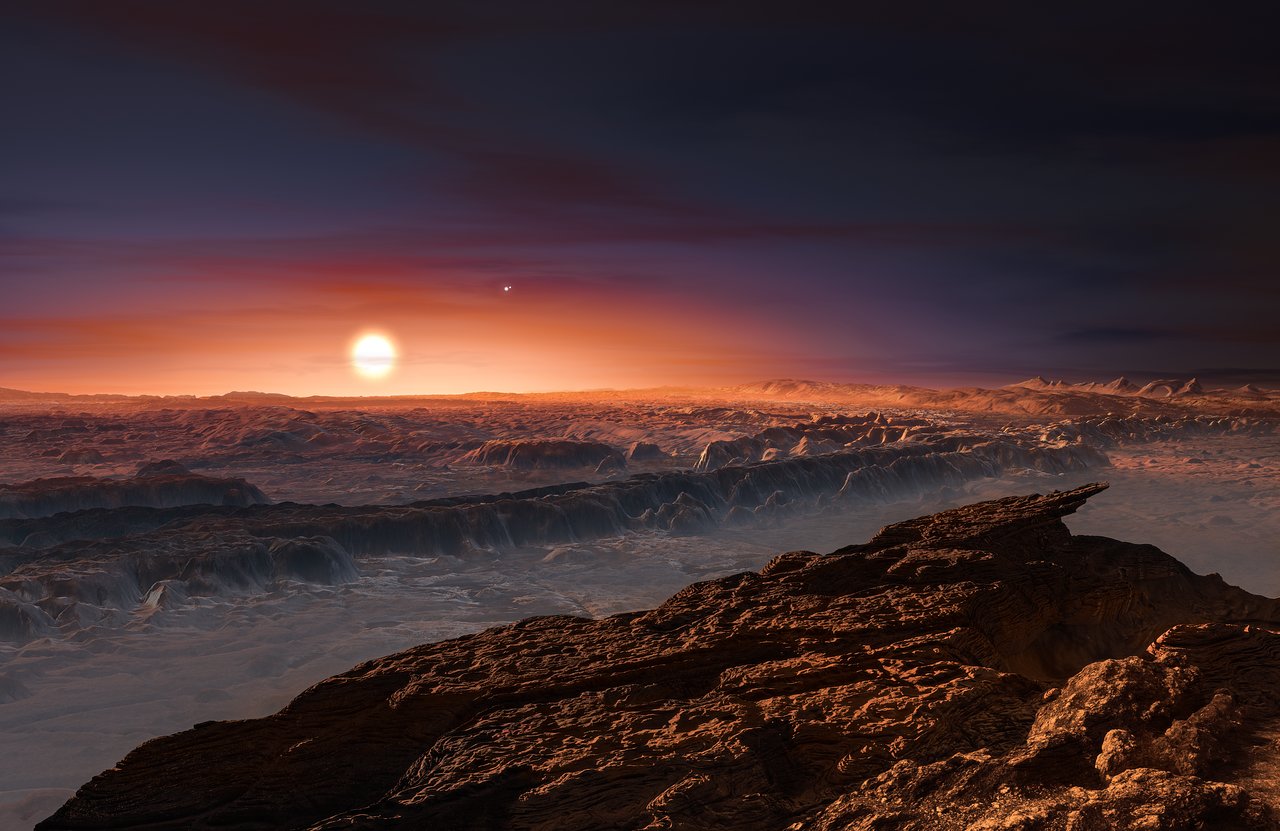
4.24 light-years. That’s it. The nearest star has a rocky planet at least 1.17 Earth masses orbiting every 11.2 days in the habitable zone. Discovered in 2016 by the same radial-velocity trick that found 51 Peg b. The star is a flare-happy red dwarf, so the surface probably gets blasted with X-rays, but underground oceans or thick clouds could shield life. Breakthrough Starshot wants to send gram-sized probes there at 20% lightspeed, arrival in the 2050s if funding holds.
James Webb is changing the game completely
Before 2022 we could only guess atmospheres. Then Webb started staring. 2023: carbon dioxide and methane on K2-18 b, a possible Hycean world. 2024: water vapour, sodium, hazy skies on hot Jupiters. 2025: tentative detection of dimethyl sulfide on K2-18 b, the same molecule phytoplankton make on Earth (still heavily debated, needs more data). Webb can’t prove life yet, but it’s already showing us worlds with thick steam atmospheres, molten rock rain, and everything in between.
The absolute weirdest exoplanets that make our Solar System look dull
• HD 189733b – beautiful deep blue planet… because its 7,000 km/h winds are made of glass shards raining sideways.
• WASP-12b – being torn apart by its star, shaped like a football, will be eaten completely in a million years.
• TOI-1431b – “ultra-hot Neptune” with 2,700°C dayside, hotter than some stars.
• HR 5183 b – eccentric giant that swings from hugging its star to 18 AU out, probably kicked by another planet.
• GJ 1214b – “steam world” wrapped in thick water vapour, surface pressure crushing.
• 55 Cancri e – possible diamond planet, twice Earth’s size, surface temperature 2,400°C, lava oceans.
How many habitable worlds are really out there?
Current best guess from Kepler, TESS, Gaia: 5–20 billion Earth-sized planets in the conservative habitable zone around Sun-like and red dwarf stars in the Milky Way. Add super-Earths, Hyceans, subsurface ocean worlds… the number explodes. Even if life is ridiculously rare, say one in a million, that’s still thousands of living planets. If it’s one in a billion, still a handful. We just have to look harder.
The next decade is going to be insane
2027–2029: PLATO and ARIEL from Europe will survey thousands of atmospheres.
2028–2035: the Extremely Large Telescope (39 m mirror) and Thirty Meter Telescope will directly image Earth-sized planets around nearby stars.
2040s: NASA’s Habitable Worlds Observatory, a huge space telescope with a starshade, designed specifically to take spectra of pale blue dots and look for oxygen, water, and seasonal changes that scream biology.
We went from zero confirmed exoplanets in 1990 to over 5,800 in 2025, from “do they even exist?” to “which one has life?” in one human lifetime. The galaxy turned out to be far bigger, far stranger, and far more full of possibility than any of us dared dream when we were kids staring at textbook drawings of nine planets. And the best part? The story is nowhere near over… it’s barely started.
Common Questions
Over 5,800 confirmed, with thousands more candidates. The NASA Exoplanet Archive updates almost weekly.
51 Pegasi b, discovered October 1995, a hot Jupiter that shocked everyone and earned Mayor & Queloz the Nobel Prize.
Transit method (Kepler, TESS) – about 75% of all discoveries.
One of the best. Seven rocky planets, three in the habitable zone, only 40 light-years away. James Webb is studying them right now.
Not yet. Possible dimethyl sulfide on K2-18 b in 2025 data, but still debated and needs confirmation.
Humans? Not soon. Tiny light-sail probes like Breakthrough Starshot could reach Proxima Centauri in 20–30 years after launch, maybe 2040s–2050s.